The historically important WWI. River Clyde 25 April ‘Gallipoli Landings, “V” Beach’ C.G.M. group. A V.C. worthy award. (6 Royal Navy officers and rates being awarded the V.C. for great gallantry at the River Clyde) On seeing that the landing bridge from the River Clyde didn’t reach the shore, jumped overboard from his ship H.M.S. Albion and with a line and got his boat beached to complete bridge from ‘River Clyde’ to shore. then under heavy enemy fire, transported multiple wounded men back to River Clyde in a rowing boat. On his second trip to the beach, he grabbed a tin of biscuits and used this to protect his back; the tin was hit three times
£17,500.00
Out of stock
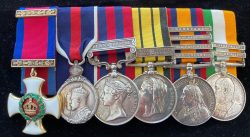
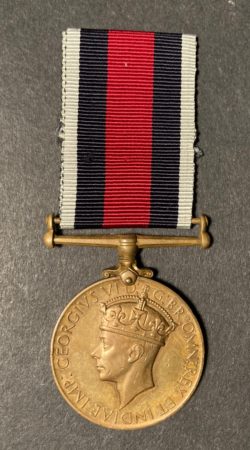
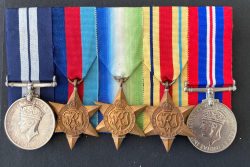
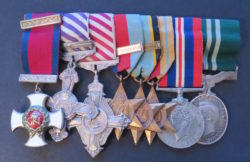
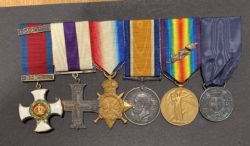
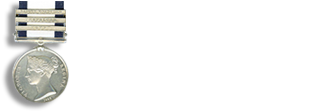
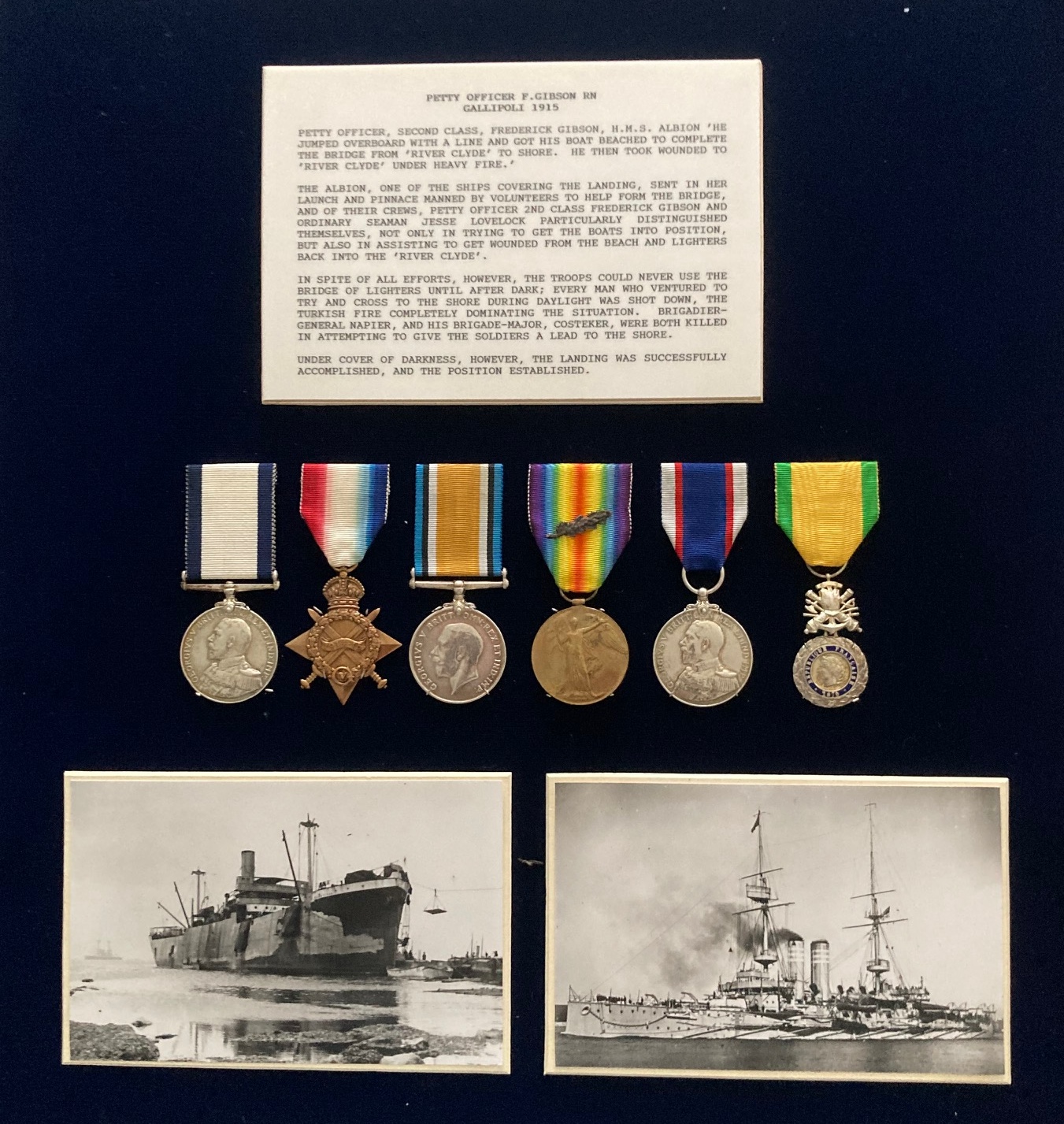
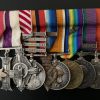
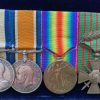
Conspicuous Gallantry Medal, (GV) ( P.O.2Cl. H.M.S. Albion.), 1914-15 Star (C.G.M., P.O.1.R.N.), British War and Victory Medals (P.O.1. R.N), with M.I.D. oakleaves, Royal Fleet Reserve Long Service Medal, (GV) (191025 ( P.O. R.F.R.), France, Médaille Militaire,
C.G.M. London Gazette, 13 August 1915 Gallipoli Campaign, Landings
Petty Officer, Second Class, Frederick Gibson, H.M.S. Albion
‘He jumped overboard with a line and got his boat beached to complete bridge from ‘River Clyde’ to shore. He then took wounded to ‘River Clyde’ under heavy fire’
Médaille Militaire London Gazette: 28 August 1918
Gallipoli Campaign – Landings 25 and 26 April 1915.
A report in the Northern Daily Mail on 1 November 1915, ‘Wingate man wins the V.C.’, ( perhaps assuming the Victoria Cross was to be) gives a first-hand account of the action by Gibson.
“I volunteered to go in and try to get a better landing stage rigged to get the soldiers ashore, but the firing was too heavy: it was impossible for me and my men and a soldier wounded in my boat within a few minutes of my arrival. I saw soldiers leave the River Clyde – only two got safely on the beach.
I busied myself doing what I could amongst the wounded dressing wounds, getting some out of the water etc, but I had to give up the work, not that I valued my own life, a thing I never thought of at the time, but the enemy had shot two of the wounded whom I had already got out of the water. One bullet shaved my hair, while another grazed my little finger. After that I had 13 wounded and seven dead in two boats put into my care for transmission to the hospital ship.
I received my thanks from the wounded and was also cheered. This seemed to give me the strength of a lion. Where I got my strength from to handle the helpless and wounded God only knows.
An officer, with two men, brought a boat to me, and we managed to get 11 off and safely back to the River Clyde. When rowing back the second time I placed a large box full of biscuits at my back safety. The box got three bullets into it.
My narrowest escape on the shore was when I left the boat. I took a few of our soldiers by surprise, for I was the only person on the beach wearing blue clothes and my black silk handkerchief was over my head to keep the sun off. One of our soldiers, thinking I was one of the enemy aimed his rifle at me, and had his bayonet fixed.
As luck would have it I was close enough to him to knock his rifle into the air. At the same time clicked off my silk handkerchief and the mistake was discovered.”
The landing commenced at 4.20 am on the 25th. The general scheme was as follows. Two main landings to take place, the first at a point just north of Gaba Tepe, the second on the southern end of the peninsula. In addition, a landing was to be made at Kum Kale, and a demonstration in force was to be carried out in the Gulf of Xeros near Bulair.
The Clyde beached 80 yards out. The Turks machine guns opened up. Many men sank owing to the weight of their equipment and were drowned. The carnage on ‘V’ Beach was chilling, dead and wounded lay at the waters edge tinted crimson from their blood. Three attempts were made to get ashore by companies of the Munsters and The Hampshire Regiment but all ended in costly failure. Further attempts to land were abandoned and the surviving soldiers waited until nightfall before trying again. The efforts of sailors to maintain the bridge from the ship to the beach, and to recover the wounded, were rewarded by six Victoria Crosses. The recipients were Commander Unwin (aged 51), Midshipmen George Drewry (20) and Wilfred Malleson (18), Able Seaman William Williams (34), Seaman George Samson (26) and Sub-Lieutenant Arthur Tisdall (24) from the Royal Naval Division (RND).
Of the approximately 1,000–1,100 men of the 1st Battalion, Royal Dublin Fusiliers who landed at ‘V’ Beach, Gallipoli, on April 25, 1915, only 11 survived the campaign completely unscathed. The battalion suffered roughly 70% casualties within the first 36 hours, leading to their amalgamation with the Royal Munster Fusiliers.
River Clyde remained beached as a dock and breakwater. Her condensers were used to provide fresh water and a field dressing station was established in the hull. She remained a constant target for Turkish gunners on the Asian shore.
Landing at “V” Beach
This beach was anticipated to be the most difficult to capture, it possessed all the advantages for defence that “W” beach had (1st Battalion Lancashire Fusiliers had embarked for “W” beach in HMS Euryalus and Implacable. The regiment had come under heavy fire from the enemy suffering many casualties). In addition, the flanks were strongly guarded by the old castle and village of Seddul Barhr on “V” beach, the whole foreshore was covered in barbed wire entanglements which extended in places under the sea. The position formed a natural amphitheatre with the stage being the beach.
The first landing here, as at all the other beaches (“W”, “X”, “Y” beaches) was made in boats, but the experiment was tried of landing the remainder of the force by means of a collier River Clyde. This steamer had been specially prepared for this occasion under the direction of Commander Edward Unwin V.C., large ports had been cut in her sides and gangways built whereby the troops could reach the lighters which were to form a bridge onto the beach.
“V” beach was subjected to a heavy bombardment similar to “W” beach, with the first attempt to land being met with heavy fire from rifle, pom-pom and machine gun, which was not opened until the boats had cast off from the steamboats.
A landing on the flanks on this beach was impossible and practically all of the first wave was either killed or wounded, though a few managed to find shelter under a bank on the beach. In several boats all were either killed or wounded. Immediately after the boats had reached the beach the River Clyde was run ashore under heavy fire on the eastern end section.
As the River Clyde grounded, the lighters which were to form the bridge to the shore were run ahead of the collier but unfortunately, they failed to reach their proper stations and a gap was left between two lighters over which it was impossible for men to cross, some men attempted to land by jumping from the lighter and wading to shore. This method proved too costly with the lighter being heaped with dead and the disembarkation was ordered to cease.
The troops in the River Clyde were protected from rifle and machine-gun fire. Commander Unwin, seeing how things were going left the River Clyde and standing up to his waist in water under heavy fire, got the lighters into position.
The bridge to the shore, though now passable, could not be used by the troops, anyone appearing on it being instantly shot, and the men in the River Clyde remained until nightfall.
At 9.50am HMS Albion sent in launch and pinnace (ship’s boat) manned by volunteer crews to assist in completing the bridge, these boats, however, could not be got into position until dark owing to heavy fire.
It had already been decided not to continue to disembark on “V” beach, and all other troops were diverted to “W” beach. The position remained unchanged on “V” beach throughout the day, the remaining crew of River Clyde did their utmost to keep down the fire directed on the men under the partial shelter on the beach.
During this period many heroic deeds were performed in rescuing wounded men from the water.
During the night of the 25-26th, the troops in River Clyde were able to disembark under cover of darkness and obtain some shelter on the beach and in the village of Seddul Bahr, this was proceeded by heavy fighting. The fight continued, supported by gunfire from HMS Albion until 1.24 pm, when the troops had gained a position from Hill 141. The hill was gallantly stormed by the troops led by Lieutenant-Colonel C.H.H. Doughty-Wylie, who fell as the position was won. The taking of this hill effectively cleared the enemy from the neighbourhood of the “V” beach, which could now be used for the disembarkation of the Allied armies. The capture of this beach called for a display of the utmost gallantry and perseverance from the officers and men of both services.
Frederick Gibson was born in Reed Street, West Hartlepool, Durham in 1880. He was a wagonway man at Littleburn Brandon and Wingate Collieries before joining the Royal Navy in 1898 for a period of 12 years. He served in various ships, his first being HMS Impregnable from 1896-97, followed by 8 further ships up to 1906. He then rejoined the Royal Naval Reserve at Chatham in March 1906 and re-enrolled in 1910 to 1916. His service saw him serve in HMS Prince George in 1914, Albion from 17 August 1914 to 18 May 1916, and 3 further ships, his last being HMS Pembroke I on 26 December 1918.
Gibson distinguished himself during the Gallipoli landings when he and Ordinary Seaman Jesse Lovelock got the boats into position and also assisted in getting the wounded from “V” beach and the lighters back into the River Clyde. Gibson jumped from HMS Albion with a line and beached his boat to complete the bridge from the River Clyde to shore. He then took the wounded to River Clyde under heavy fire. Both men were awarded the rare and historically important Conspicuous Gallantry Medal.