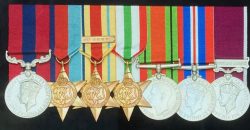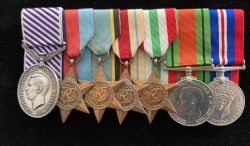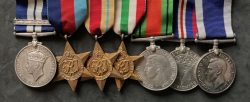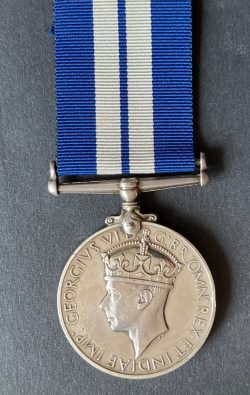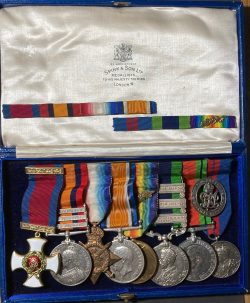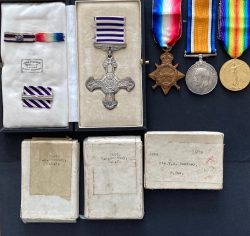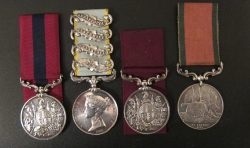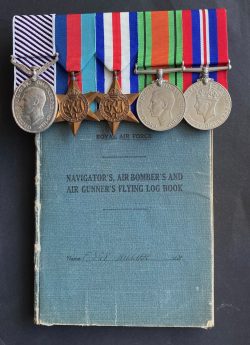
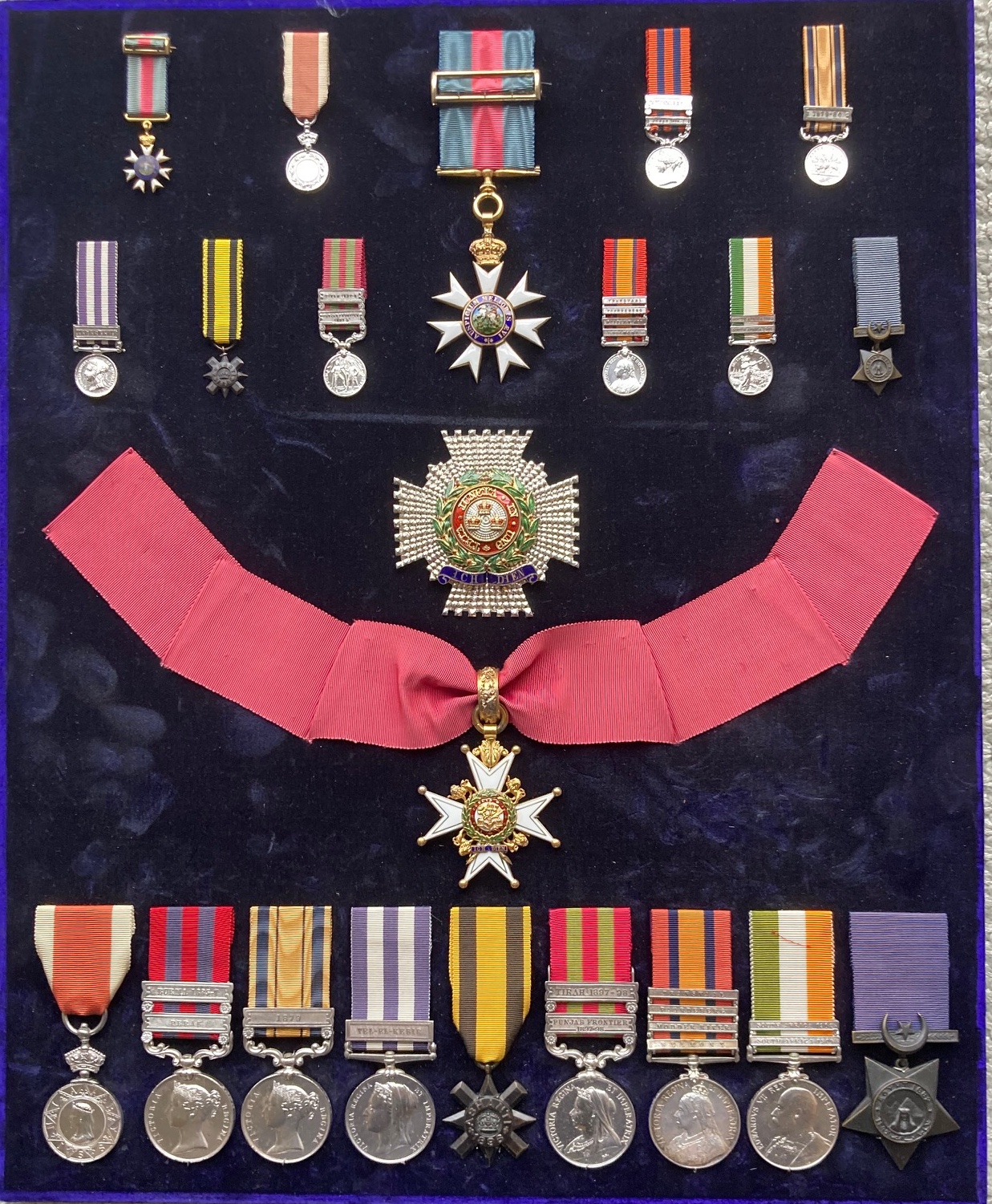
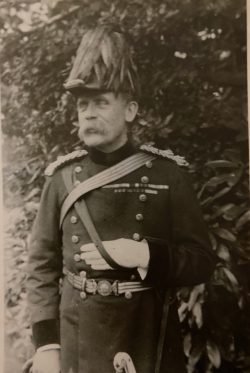
The most remarkable combination of 8 campaign medals to Surgeon General Sir Edmon Townsend, KCB, CMG from Abyssinia to the Boer War. A surgeon at the ‘sharp end’ was severely wounded in Perak , engaged with three Malays, he shot one at point blank but felled by the others being saved by two Bluejackets, both awarded the CGM. In the Boer War despite of advancing age and the most senior rank of Surgeon General was in the firing line at Tweefontein tending the wounded until three times dangerously wounded. His service spanning Abyssinia , battle of Arogee, the Zulu War, Ulundi, Egypt, Kassassin and Tel-el-Kebir, Burma 1885, Ashanti 1896, India , Arhanga Pass, and Bazar Valley actions and Boer War
£9,800.00
Out of stock
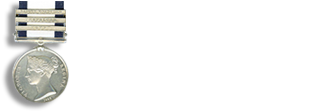
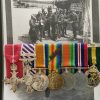
Knight Commander of the Order of the Bath (K.C.B.), neck badge and breast badge, silver gilt and enamelsOrder of St Michael and St George breast badge, ; Abyssinia (Asst. Surg Army Med Staff), Indian General Service Medal 1854, 2 clasps, Perak and Burma 1885-7, (Sug. Major, Army Med Staff) South Africa clasp 1879, (Surg. Maj.A.M.D.), Egyptian medal 1882, clasp Tel-el-Kebir (Surg. Maj. A..M.D.), Ashanti Star 1896, (unnamed as issued), India Medal 1895, 2 clasps, Punjab Frontier 1897-98 and Tirah 1897-98, (Surgn. Col), Queens South Africa ,4 clasps, Belmont, Moder River, Paardeberg and Transvaal;, (Surg.. Genl C.B. C.M.G RAMC) , King’s South Africa, 2 clasps. (Surgn. Genl. M.D. C.B. C.M.G. RAMC), Khedive’s Star 1882
Together with the recipient’s miniature awards display mounted in an old glazed frame
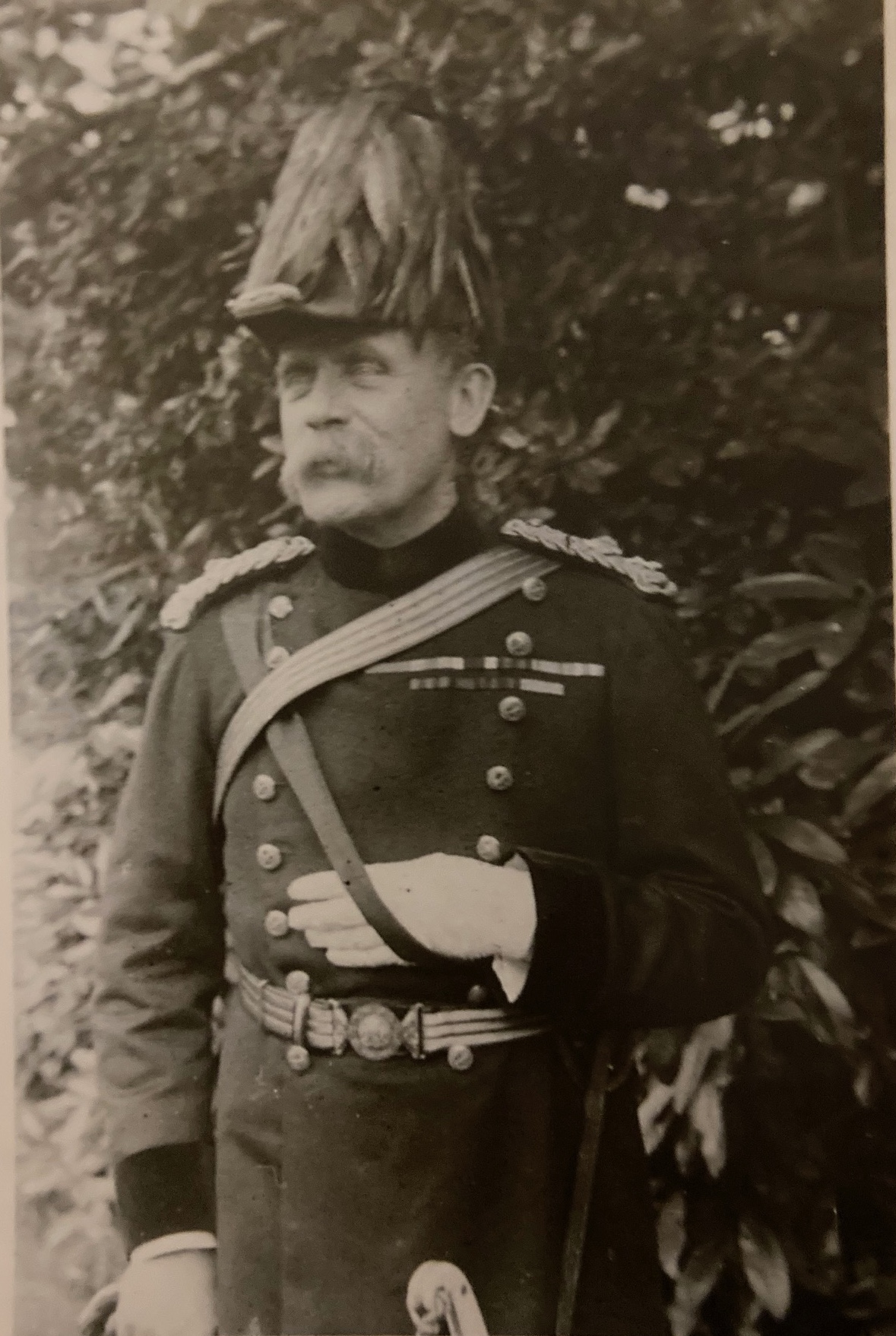
Edmond Townsend
Sir Edmond Townsend (22 April 1845 – 2 January 1917) was an Anglo-Irish physician and senior officer in the British Army Medical Department, renowned for his 38-year military career that included service in nine overseas campaigns and recognition for bravery under fire.
Born in Cork, Ireland, as the fifth of thirteen children to Dr. W. C. Townsend, MD, he earned MA, MD, and MCh degrees from Queen’s University of Ireland before commissioning into the Army Medical Staff on 1 April 1867. Townsend advanced through the ranks, serving in key roles such as principal medical officer at the Royal Victoria Hospital in Netley until his retirement in 1905, during which time he was both severely and dangerously wounded in action on multiple occasions.
He was mentioned in despatches five times and received numerous decorations, culminating in his knighthood as Knight Commander of the Order of the Bath (KCB) in 1904 for distinguished service.
After retiring, Townsend divided his time between London and Ireland, passing away at his home in Clontymore, County Cork, at the age of 71.
Townsend completed his medical education at Queen’s University of Ireland, earning the degrees of M.A., M.D., and M.Ch. in 1866.] The M.Ch. degree underscored his focus on surgery, a field that aligned with his family’s longstanding involvement in medicine. Having finalised his qualifications the year prior, Townsend entered the British Army as an assistant surgeon on 1 April 1867.
Military career
Townsend entered the British Army Medical Department as an assistant surgeon on 1 April 1867.
Shortly after his commission, he participated in the Abyssinia campaign of 1867–68, serving with the expeditionary force that advanced into the Ethiopian highlands. He was present at the decisive Battle of Arogee on 10 April 1868, where British and Indian troops routed Emperor Tewodros II’s army,
On 1 March 1873, Townsend was promoted to the rank of surgeon.
Townsend’s service continued with the Perak Expedition of 1875–76 in the Malay Peninsula, along the Perak River, he was attached to the Buffs (East Kent Regiment) and served with the Laroot Field Force. On 4 January 1876, while advancing on the village of Kota-lama, Townsend was severely wounded in close-quarters combat with Malay warriors; he fell after being struck but was rescued by two British sailors, Henry Thompson and Harry Bonnett, who dispatched his attackers. (Both awarded the C.G.M..)
From the despatch L.G. February 18 1876. Action at Kotalama , 4 January , 1876
’Surgeon Townsend was the first to be assailed, he being a little advanced; three Malays assailed him with spears, the centre one he shot with his pistol, and the man falling forward knocked him down. The other two were driving at him when Harry Bennett, A.B. and William Thompson, A.B. rushed forward and killed them both.’
Townsend received promotion to surgeon-major on 1 April 1879,
During the Anglo-Zulu War of 1879, Townsend served as Principal Medical Officer for the Northern Column and subsequently Wood’s Column, providing critical medical support during the Battle of Ulundi and operations against King Sekhukhune. mention in dispatches,
In the Anglo-Egyptian War of 1882, Townsend participated in the actions at Kassassin on August 26th and 28th, as well as the Battle of Tel el-Kebir,
Townsend’s service extended to the Third Anglo-Burmese War from 1885 to 1886,
On 1 April 1893, Townsend was promoted to brigade-surgeon-lieutenant-colonel, during the Ashanti Expedition of 1895–96, Townsend’s organisational skills were again noted, leading to a mention in dispatches and the award of the Ashanti Star.
Served as Principal Medical Officer under Sir William Lockhart during the North-West Frontier campaigns of 1897–98, including the Mohmand, Samana, Arhanga Pass, and Bazar Valley actions. (C.B.)
During the Second Boer War (1899–1902), Colonel Edmond Townsend (Promoted Surgeon General. 1901), served as Principal Medical Officer (PMO) of the 1st Division under Lieutenant-General Lord Methuen, participating in key engagements including the actions at Enslin, Modder River, Magersfontein, Paardeberg, and the relief of Kimberley. After the engagement at Belmont on 23 November 1899, Methuen noted that “this is the most perfect work I have ever heard of in war, and reflects the highest credit on Colonel Townsend,” highlighting the rapid transport of all wounded by the following day. Townsend was mentioned in dispatches for his services in this dispatch dated 23 November 1899.
Later in the war, Townsend transferred to the role of PMO for the Western District. On 7 March 1902, during the Battle of Tweebosch (also known as Klipdrift), his column was ambushed by Boer forces under General Koos de la Rey; Townsend remained in the fighting line until sustaining three dangerous wounds, demonstrating gallantry throughout the campaign.[
Methuen commended him in a dispatch dated 13 March 1902 from Klerksdorp, stating: “Colonel (Sic) E. Townsend, C.B., my P.M.O., remained in the fighting line until receiving three wounds; he has acted most gallantly from the beginning of the campaign.” For his Boer War service, Townsend received the Queen’s South Africa Medal with four clasps (for Paardeberg, Relief of Kimberley, Modder River, and Belmont/Enslin) and the King’s South Africa Medal with two clasps (for 1901 and 1902). In recognition of his contributions up to November 1900, he was appointed Companion of the Order of St. Michael and St. George (CMG) effective 29 November 1900, gazetted in April 1901.
Townsend’s exemplary leadership led to his promotion to Surgeon-General on 25 September 1901, the highest medical rank in the British Army. He departed South Africa in April 1902 aboard the SS Walmer Castle, arriving at Southampton in early May.
In the final years of his active military career, Edmond Townsend held senior administrative roles within the British Army Medical Services. He served as Surgeon-General from 1901 until his retirement, overseeing key aspects of medical administration during a period of post-Boer War reorganization. In October 1902, Townsend was appointed Principal Medical Officer at Netley Military Hospital, where he managed the facility’s operations as one of the premier institutions for military medical training and treatment.
On 24 June 1904, Townsend was knighted as a Knight Commander of the Order of the Bath (KCB) in recognition of his distinguished service. This honor elevated his status within the medical and military establishments.
Townsend retired from the army on 22 April 1905, after 38 years of service dating back to his entry on 1 April 1867. He was placed on retired pay as Surgeon-General Sir Edmond Townsend, KCB, CMG. Following retirement, he resided in London and at Clontymore in County Cork, Ireland,
Surgeon-General Sir Edmond Townsend died on 2 January 1917 at the age of 71 at his home, Clontymore, County Cork, Ireland.
His passing concluded a 38-year career in the British Army Medical Department, spanning service from 1867 until his retirement in 1905 and encompassing participation in nine overseas campaigns.