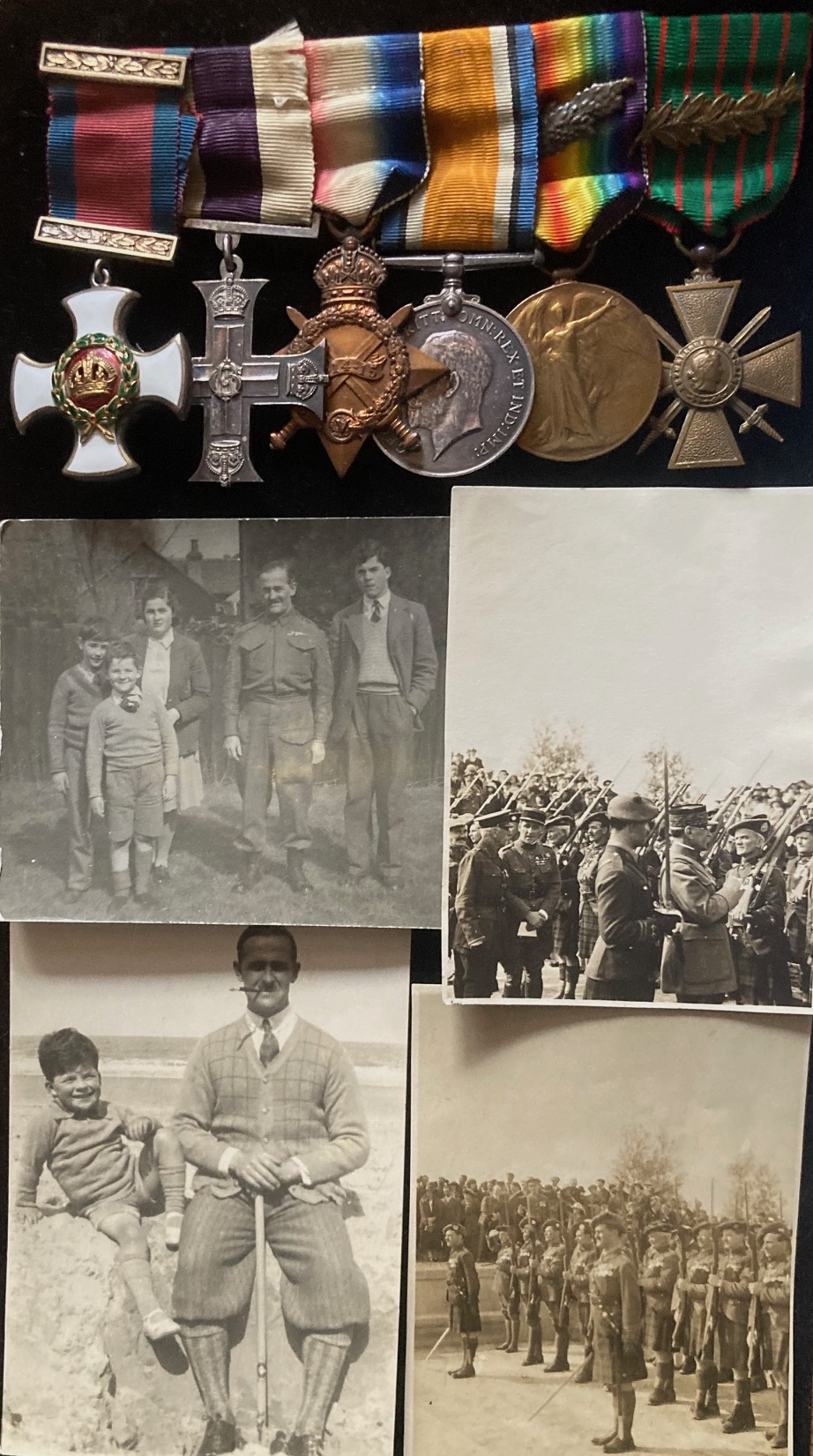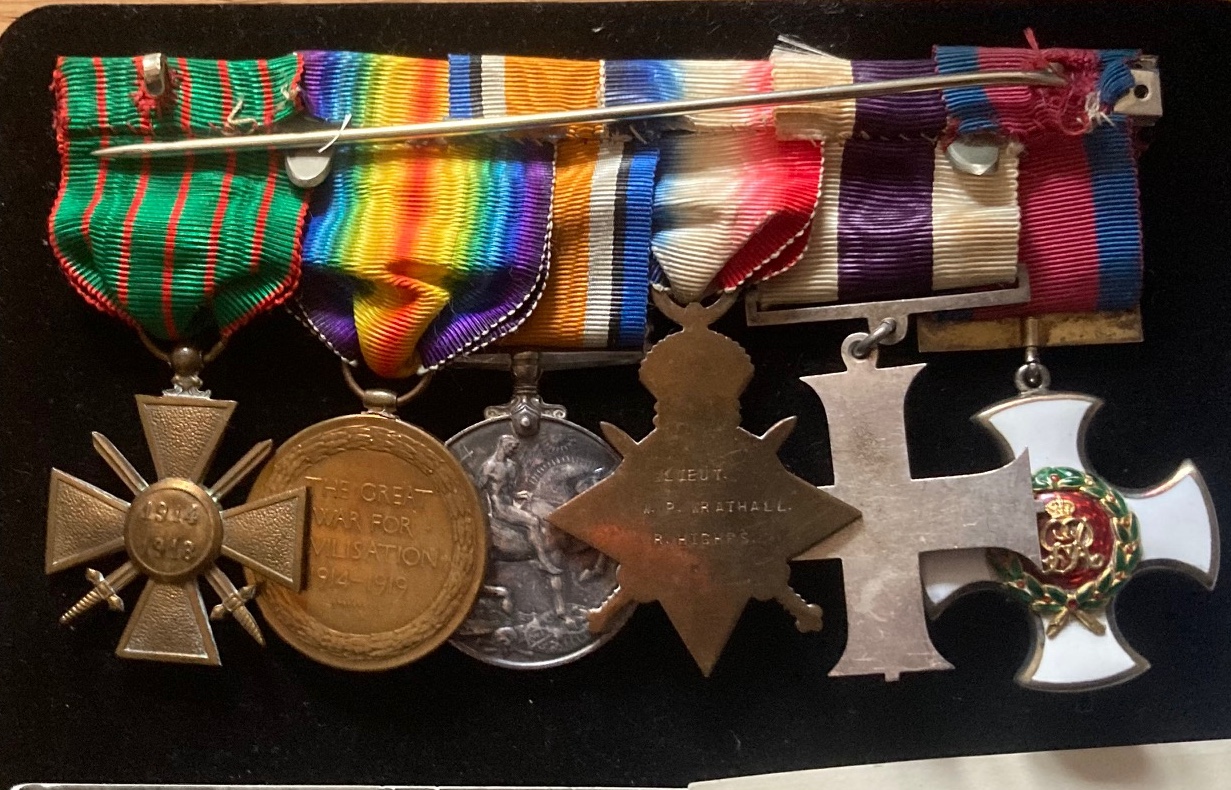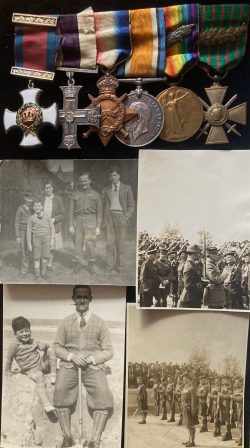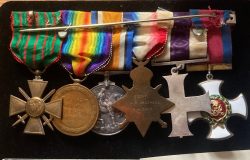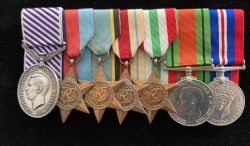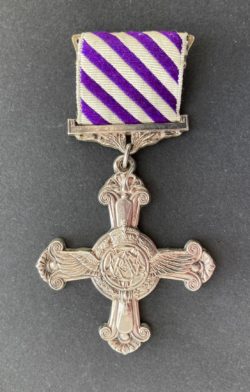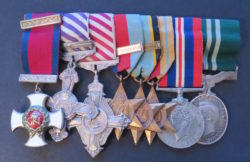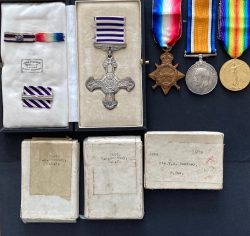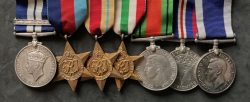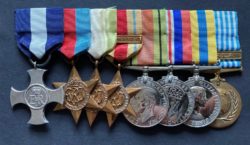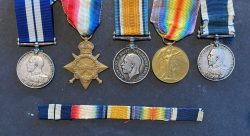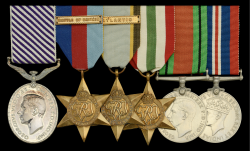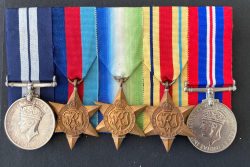
Distinguished Service Order, (GV.), silver-gilt and enamel, with top riband bar, Military Cross, (GV)., 1914-15 Star (Lieut. R. Highrs.), British War and Victory Medals, with M.I.D. oak leaves (Capt. ); France, Croix de Guerre, bronze, reverse dated 1914-1918, with bronze pal
W.P. Wrathall
Mounted as worn.
D.S.O. London Gazette 16 September 1918:
‘For conspicuous gallantry and devotion to duty. This officer took over temporary command of the brigade at a time when it was much depleted after 48 hours’ fighting, and consisted of small parties of various battalions, holding a line of over 5,000 yards, covering two battalions of another Division who were digging. For the best part of three days he was untiring in his efforts, collecting scattered parties and organising the hastily occupied and extended line. In particular when Brigade Headquarters had been rushed by the enemy and nearly surrounded, it was due to his energy that the personnel was extricated with little loss. His personal reconnaissances and unfailing resource in dealing with difficulties were the mainstay of the line.’
M.C. London Gazette 1 January 1918
M.I.D. London Gazettes 1 January 1916, 4 January 1917, and 20 December 1918.
French Croix de Guerre London Gazette 7 January 1919.
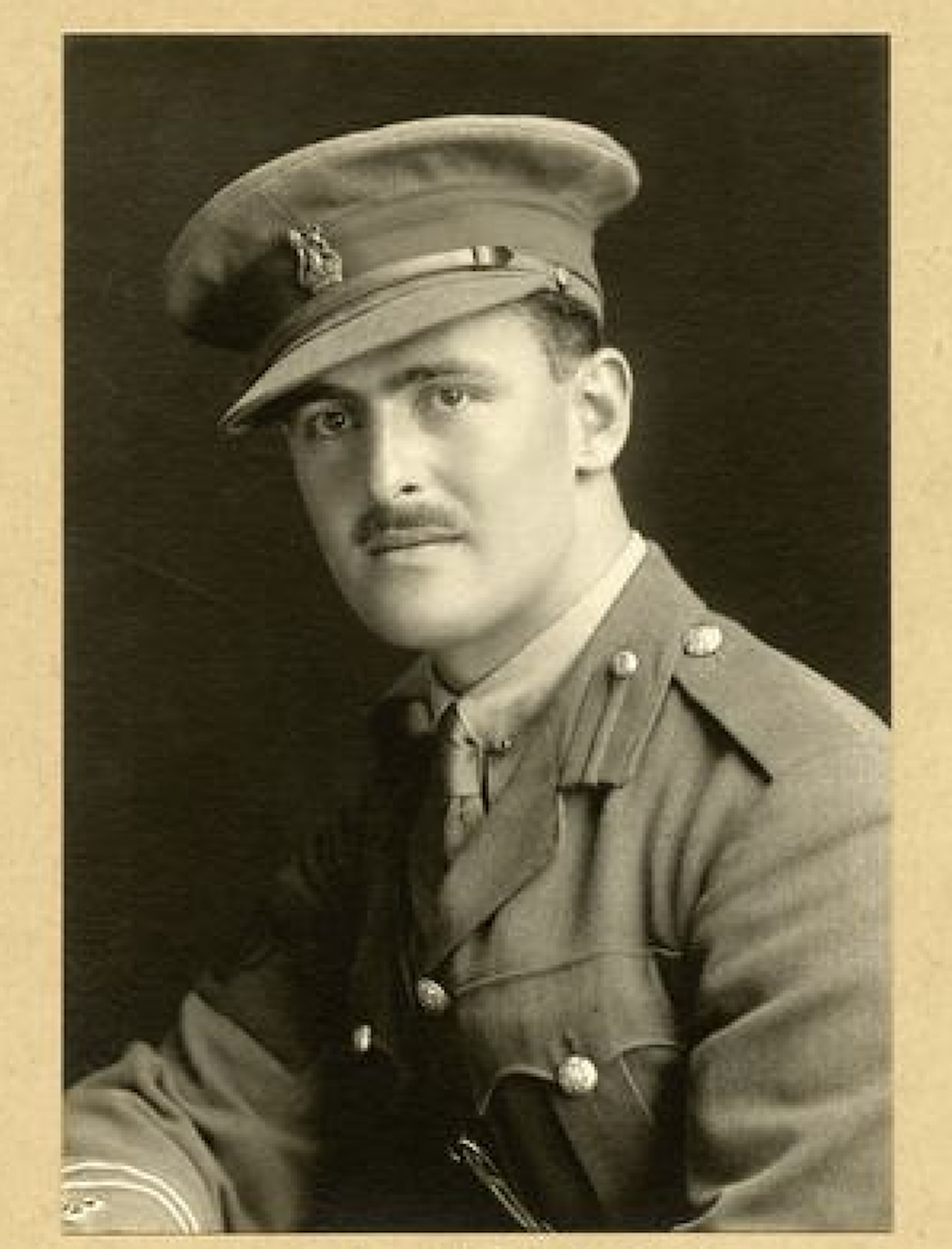
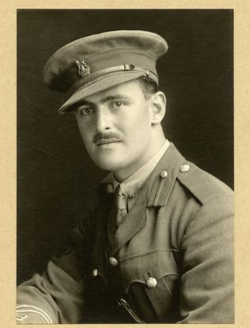
William Parker ‘Billy’ Wrathall was born in 1894, the son of William Wrathall, a stone mason contractor from Grassington, North Yorkshire, and at the age of 11 had moved with his father to Belgium; William Snr, whose trade was stone, the younger Wrathall set up his own company, Wrathall Père et Fils, contracted to supply the marble to the fast-growing chain of Lyons Corner Houses opening in England.
On holiday in Scotland in August 1914 when war broke out, Wrathall, then aged 20, immediately enlisted and was commissioned Second Lieutenant in the 6th (Perthshire) Battalion, Royal Highlanders (Black Watch), Territorial Force on 13 August 1914. He was promoted Lieutenant on 19 December 1914, and served with the 6th Battalion during the Great War on the Western Front from 2 May 1915, first seeing action at the Battle of Festubert. Mentioned in Despatches in January 1916, he was promoted Captain on 1 June 1916, and was wounded in action on 31 July 1916, during the Battle of the Somme – the previous day the Battalion was involved in an attack on the eastern corner of High Wood; they advanced within 30 yards of the enemy’s front line, but suffered heavy casualties amongst the leading companies, and were held down under heavy fire until ordered to withdraw at daybreak on 31 July. The battalion suffered total casualties of 260, including Wrathall, who retained a shard of shrapnel in his thigh for the rest of his life.
Returning to the Front as soon as he had recovered, Wrathall was Mentioned in Despatches for a second time in January 1917. He was awarded both the Military Cross and the Distinguished Service Order. Mentioned in Despatches for a third time in December 1918, and awarded the French Croix de Guerre, Wrathall was appointed Brigade Major on 8 April 1919, prior to being demobilised later that same year.
Following the cessation of hostilities, Wrathall returned to Belgium to work for the family business which, after diversifying into metals, eventually changing its name to the Anglo-Belgian Steel Corporation, which had offices on the Rue Royale in Brussels. He retained links with his regiment having been chosen to command the British detachment at the unveiling of the Memorial to the Fallen of the 51st Highland Division at Beaumont-Hamel when it was unveiled by Marshal Foch in September 1924.
Following Germany’s invasion of Belgium in 1940, Wrathall, and his fled to England with all they could carry. However, as a prominent member of the Brussels Chamber of Commerce with connections in the United Kingdom (for services to which he was awarded the Belgian Order of the Crown). According to family sources, he was co-opted into helping to evacuate the Bank of Belgium’s gold reserves – in suitcases – across the Channel for safekeeping in England. But on returning to Zeebrugge after one such trip and learning that Brussels was under occupation, he commandeered a lorry, drove to Dunkirk and came back, along with members of his old battalion of the Black Watch, with the Little Ships.
Sold with:
The recipient’s original Commission Document, dated 13 August 1914, with War Office enclosure, in original transmission envelope.
iBestowal Document for the D.S.O., dated 16 September 1918, in original transmission envelope; together with a copy of the Statues of the Order.A caricature drawing of the recipient, mounted in a glazed frame; together with four postcard photographs.
Cape Matapan’ Immediate D.S.M. group of five awarded, Leading Seaman, R.N., later killed in action during the Dieppe Raid, on 19 August 1942, serving in Landing Craft 145