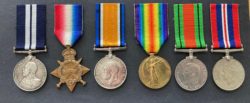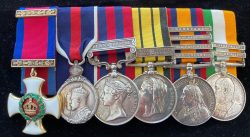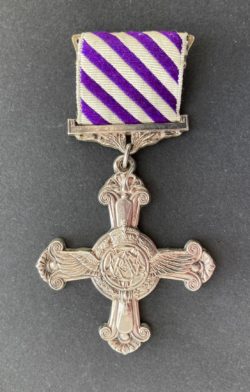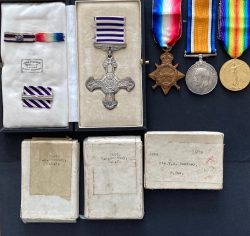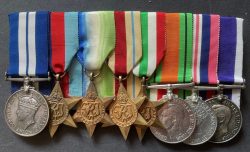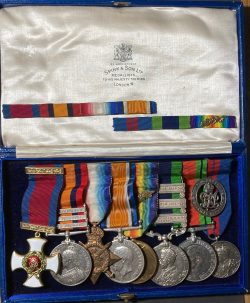
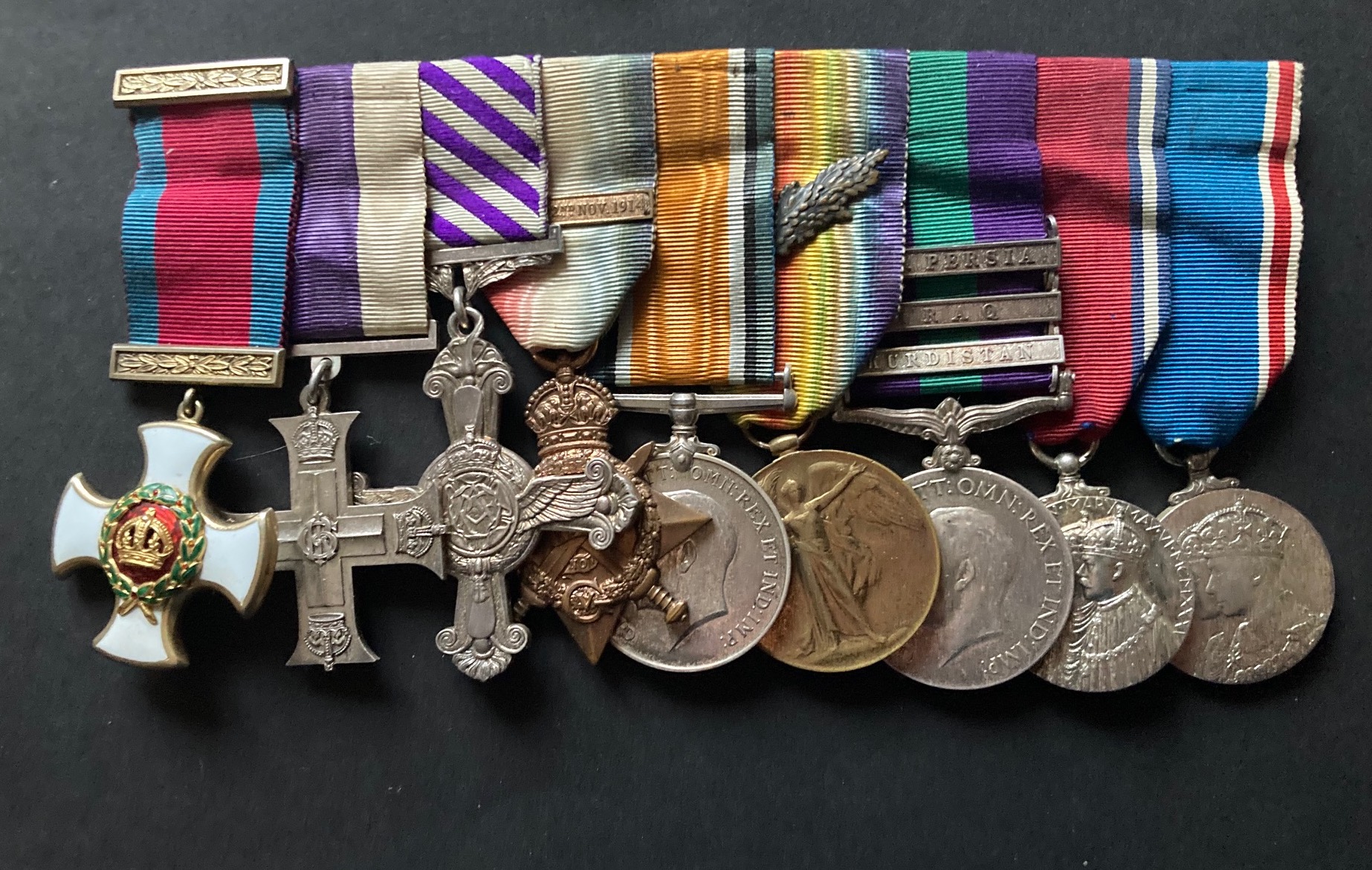
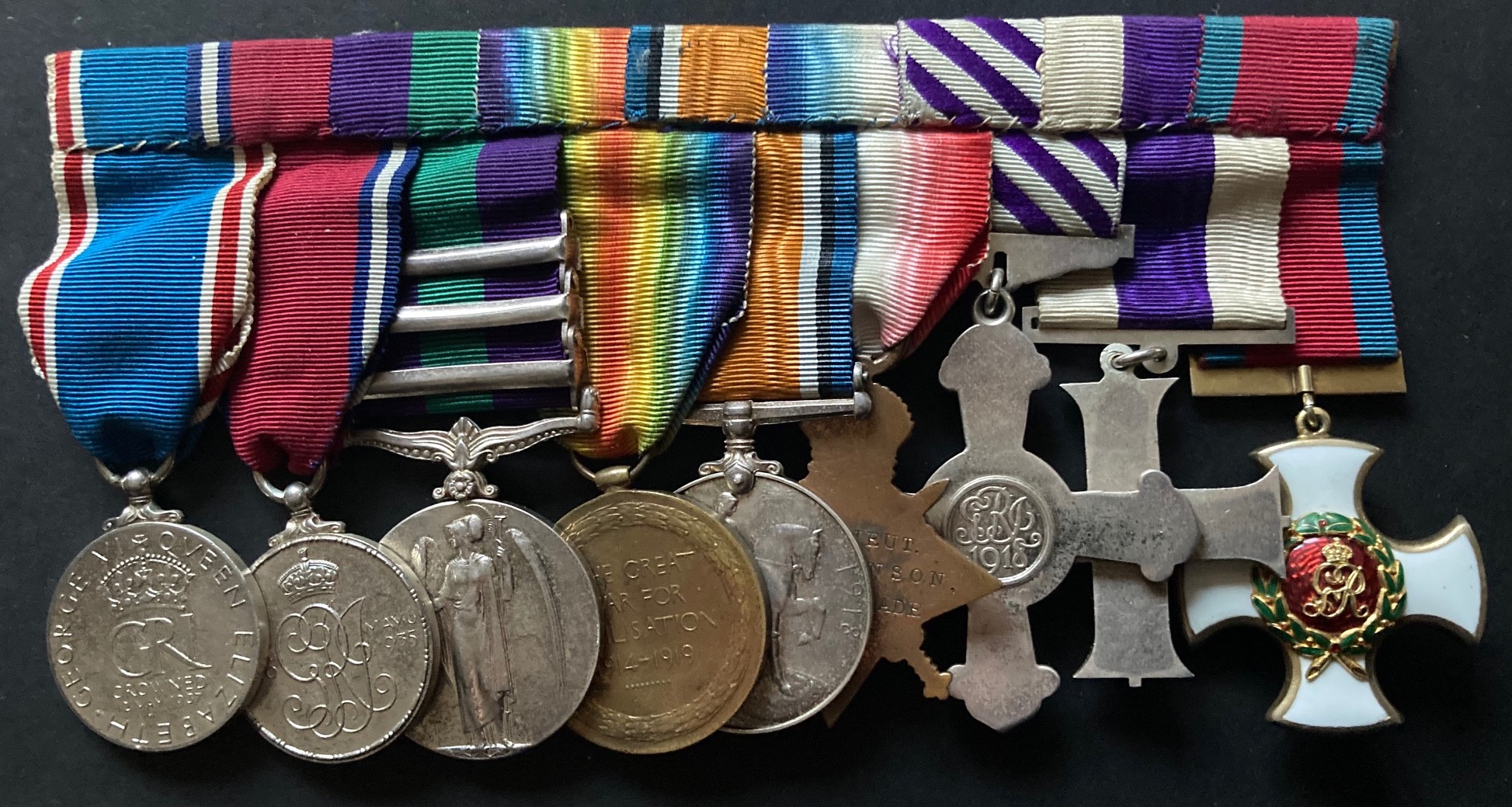
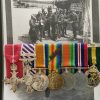
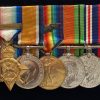
D.S.O., (GV), silver-gilt and enamel, M.C. (G.V), D.F.C (GV), 1914 Star, with clasp (2nd Lieut. F. L. Robinson, R.M. Brigade); British War and Victory Medals, M.I.D. (Major F. L. Robinson, R.A.F.), G.S.M., 3 clasps, Kurdistan, Iraq, N.W. Persia (F./L. F. L. Robinson, R.A.F.), Jubilee 1935, Coronation 1937,
D.S.O. L.G. 5/4/1919
‘A very gallant and able Squadron Commander (R.N.A.S.), who, by his fine leadership and personal example, raised the morale of his command. By his untiring energy he has rendered most valuable service on reconnaissance duty and bombing raids.’
M.C. L.G. 3/9/1915 an award for his position under fire at the observation high point at Ypres Cathedral
‘For conspicuous gallantry and devotion to duty as Artillery Observing Officer (R.M.A.) between 30 July and 10 August 1915, when posted on a high building in the neighbourhood of Ypres. The building was continually shelled by the enemy with heavy guns, but he maintained his position, a most precarious and dangerous one, even when the building was in imminent danger of falling, and supplied valuable information throughout.’
D.F.C. L.G 28/10/1921
‘For continuous good work, gallantry and devotion to duty. This Officer has flown over 100 hours during operations and has shown at all times an untiring example throughout. He has had three machines put out of action by hostile fire from the ground.’
M.I.D. L.G 1/1/1916.
Franks Lubbock Robinson, born in 1886 and educated at Edinburgh House and St Columbia’s College, Dublin.
Royal Marine Brigade 1914 – R.M.A. Howitzer D.S.C. 1915
Commissioned into the Royal Marine Artillery as a 2nd Lieutenant in September 1914, and embarked for France with the Royal Marine Brigade, and served in the 12-pounder battery at Dunkirk, served In February 1915, however, with No. 2 Howitzer, R.M.A., under Major G. L. Raikes, which gun first went into action at Neuve Chapelle that March, and for his subsequent deeds in Ypres in late July and early August 1915 t won his M.C.
From ‘The Royal Marine Artillery 1804-1923, by Edward Fraser and L. G. Carr-Laughton’
‘Observation was especially important in the case of howitzers, and was carried out in the face of many difficulties. In the northern area the flatness of the country, and the destruction of high buildings by the enemy, had to be reckoned with. In these circumstances an Observation Post was maintained in Ypres Cathedral which commanded the whole salient. In the summer of 1915, when there was little firing, this post was manned by officers from the howitzers as a general look-out post, and valuable information was obtained. The cathedral was a favourite target of the enemy batteries which extended round it in a semi-circle, but although the observers had some narrow escapes, there were no casualties. Captain G. L. Raikes, and Lieutenants F. L. Robinson and T. Cuming were awarded the D.S.C. (sic) at the end of the year, chiefly in recognition of this service.’
Pilot – Squadron Command in Mesopotamia – D.S.O.- Iraq 1919-21 – D.F.C.
In 1916, as per his Times obituary notice, Robinson ‘was seconded to the Royal Flying Corps as an Observer and within four months qualified as a pilot, and was given a Flight Command in France.
In 1917 he took command of No. 63 Squadron but,
From ‘The Sky Their Battlefield’,
‘No. 63 Squadron had arrived in Mesopotamia on the 13th of August [1917]. Amongst the aircraft they brought were R.E.8s which held out the hope of greatly improved performance. The fate that befell its personnel, however, was indicative of the problems the weather caused that summer for within weeks the unit was reduced by sickness and exhaustion to a bare handful of men. The Squadron had worked up and trained in Northumberland, only to be delivered into almost unendurable conditions, in which some of their number actually died. Those few still able to work struggled on with the erection of their machines, which like many others already there were soon also deteriorating. These factors delayed the start of operations for the unit and are bound to have contributed to some of its early losses. The first completed R.E.8s reached Samarra airfield in Baghdad on the 14th September. It had two reconnaissance Flights of these machines, as well as a fighting Flight of SPADs, Bristol Scouts and Martinsyde G100s. The first reconnaissance the unit carried out was on the 25th, and both machines involved were lost.’
By October 1917, however, No. 63 was ready to participate in operations on the Tigris front, where in fact it lent most of the air support, carrying out reconnaissance, bombing and contact patrols in the presence of ever growing numbers of German aircraft – six of 63’s machines were shot down or damaged in subsequent retaliatory raids on the enemy’s airfield at Kifri. And as the campaign progressed, so moved 63 Squadron to airfields anew until, in September 1918, it arrived at Tikrit for the final push up the Tigris, its bombing and machine-gunning reaping havoc among the retreating Turks, not least at Fat-ha Gorge in late October. Robinson was awarded the D.S.O.
Moreover, and still with 63 Squadron, he was subsequently present in operations to suppress the rebellions in Kurdistan and in Iraq in 1919-21, in addition to further operations in N.W. Persia, and thrice had his aircraft put out of action by enemy ground fire. He was awarded the D.F.C.
Promoted to Group Captain and command of the depot at R.A.F. Uxbridge and also as C.O. of R.A.F. Amman 1933-35, and was appointed an A.D.C. to the King. Robinson, who retired in May 1939, held the R.A.F. Squash Rackets Championship for several years in succession, the last occasion being in 1932 at the age of 46. Died 1949.
Related products