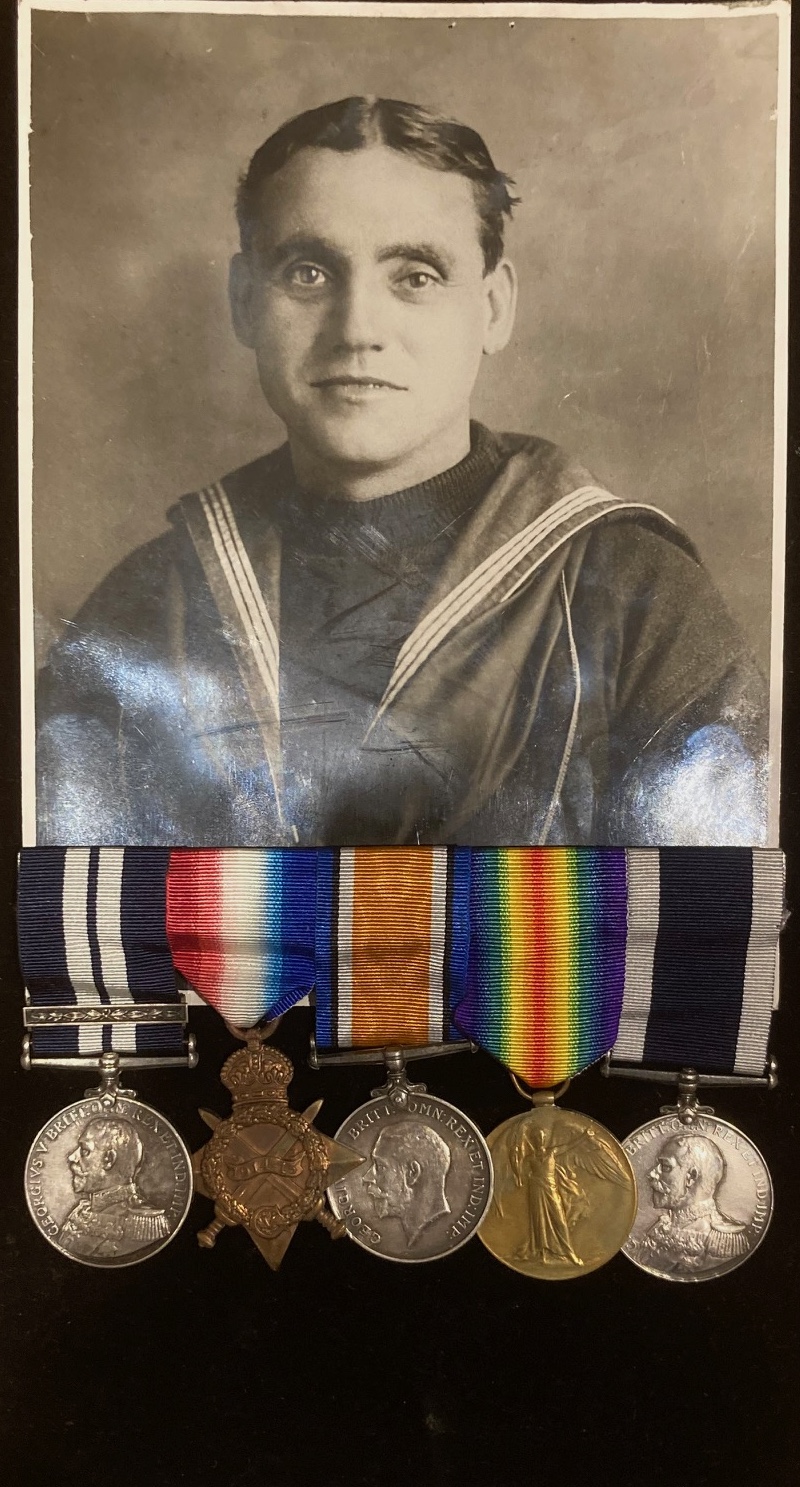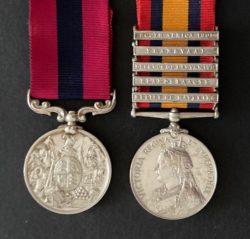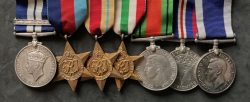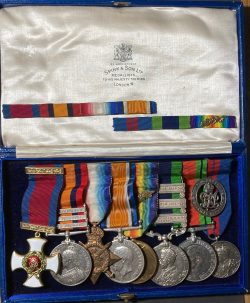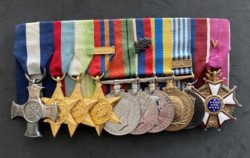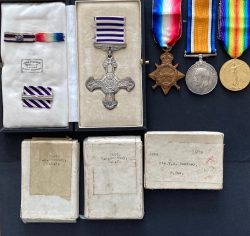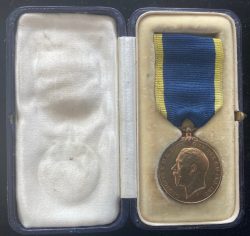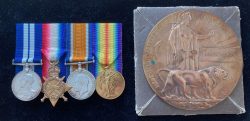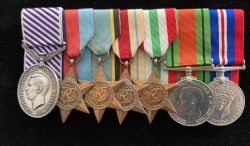
Distinguished Service Medal, (GV), (P.O. H.M.S. Milne. 9 May 1917) with Second Award Bar, the reverse officially dated ‘1917’, 1914-15 Star (P.O., R.N.), British War and Victory Medals (1C.P.O. R.N.);,Royal Navy L.S. & G.C., G.V.R., 1st issue (189448 Frederick Robinson, C.P.O. H.M.S. Milne.) mounted as worn, generally very fine (5
D.S.M. London Gazette 22 June 1917. The recommendation states:
‘Coxswain H.M.S. Milne. Ramming of German Submarine UC26 9 May 1917. For the prompt and capable way he carried out my orders while at the helm.’ (ADM 137/2098 refers).
Bar to D.S.M. London Gazette 26 April 1918: ‘For operations on the Belgian Coast.’
Only 67 bars and two second bars were awarded to the D.S.M. during the Great War.
Frederick Robinson joined the Royal Navy in 1897 and served aboard H.M.S. Milne during the Great War. The D.S.M. action was for the destruction of the German submarine UC.26 off Calais and is graphically described by Taprell Dorling in his book Endless Story:-
‘At dawn on May 9th, UC.26 was suddenly sighted on the surface north-west of Calais by the destroyer Milne, Commander V. L. A. Campbell, D.S.O. The submarine attempted to dive; but delayed a few seconds too long. Campbell, as quick as his look-outs, had instantly altered course and increased to full speed, steadying his ship for her target. UC.26 was gradually getting lower and lower in the water as she strove to escape. The moments seemed interminable. Would the Milne reach her before she disappeared?
She did, striking her just before the conning-tower, when the latter was still clear of the surface. The steel ram at the bottom of the destroyer’s stem crashed through the submarine’s hull like cardboard. Overwhelmed by a torrent of water spurting in through the great gash, UC.26 sank in a rush and struck heavily on the bottom, where she was depth-charged by two other destroyers. There was, however, still a chance of escape for the 28 officers and men inside her. As the water rose within the hull, the pressure of air increased and formed various air-locks. Seven men actually managed to open the engine-room hatch, 5 of whom seemed to have come to the surface. But only 2 were picked up alive.
The Milne came back into harbour with pieces of the submarine’s plating still sticking to her ram, and for this smart piece of work Commander Campbell received a bar to the D.S.O. he had already earned with the Royal Naval Division in Gallipoli. Lieutenant Pearson, the officer of the watch, who had first seen UC.26, was awarded the D.S.C., while the coxswain, Frederick Robinson; a leading signalman, Leonard Pearson; and two men of the engine-room department, Ernest Pike and John Reason, were all granted the D.S.M.’
For his continued good services in the Milne with the Dover Patrol on the Belgian Coast, Bar to the D.S.M.
Sold with original parchment Gunnery & Torpedo History Sheet, parchment Certificate of Service to September 1812, and portrait photograph.
D.F.M. group, a fine group covering service with 22 (Beauforts), the top secret 1474 Flight (anti radar) becoming 192 Sqdn. One of the crew in March 1941 which attacked a convoy sinking a 5000 tonner by torpedo at 50 foot height. One of 6 aircraft detailed for the torpedo attack on Gneisnau at Brest in which P/O Cambell won a posthumous Victoria Cross in alone pressing home a suicidal torpedo attack. Later served with the top secret Flight 1474 embedded within Bomber Command raids and tasked with'cracking' the secrets of German Radar