-
×
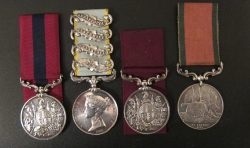
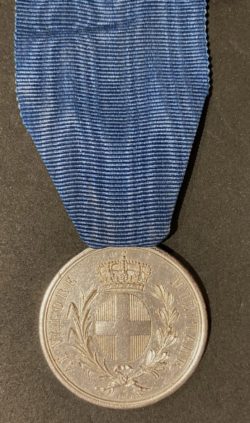 Sardinian War Medal of Valour, 'Al Valore Militaire 'Spedizione D'Orient 1855-56' Bt. Major, Rl Arty. Very severely wounded at Sebastopol
1 × £1,400.00
Sardinian War Medal of Valour, 'Al Valore Militaire 'Spedizione D'Orient 1855-56' Bt. Major, Rl Arty. Very severely wounded at Sebastopol
1 × £1,400.00
Subtotal: £1,400.00
 Sardinian War Medal of Valour, 'Al Valore Militaire 'Spedizione D'Orient 1855-56' Bt. Major, Rl Arty. Very severely wounded at Sebastopol
1 × £1,400.00
Sardinian War Medal of Valour, 'Al Valore Militaire 'Spedizione D'Orient 1855-56' Bt. Major, Rl Arty. Very severely wounded at Sebastopol
1 × £1,400.00 Subtotal: £1,400.00
£46,000.00
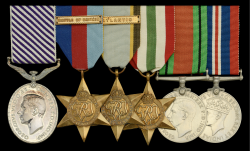
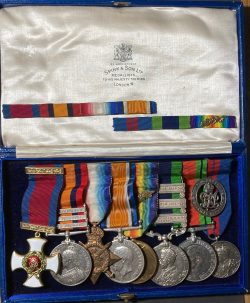
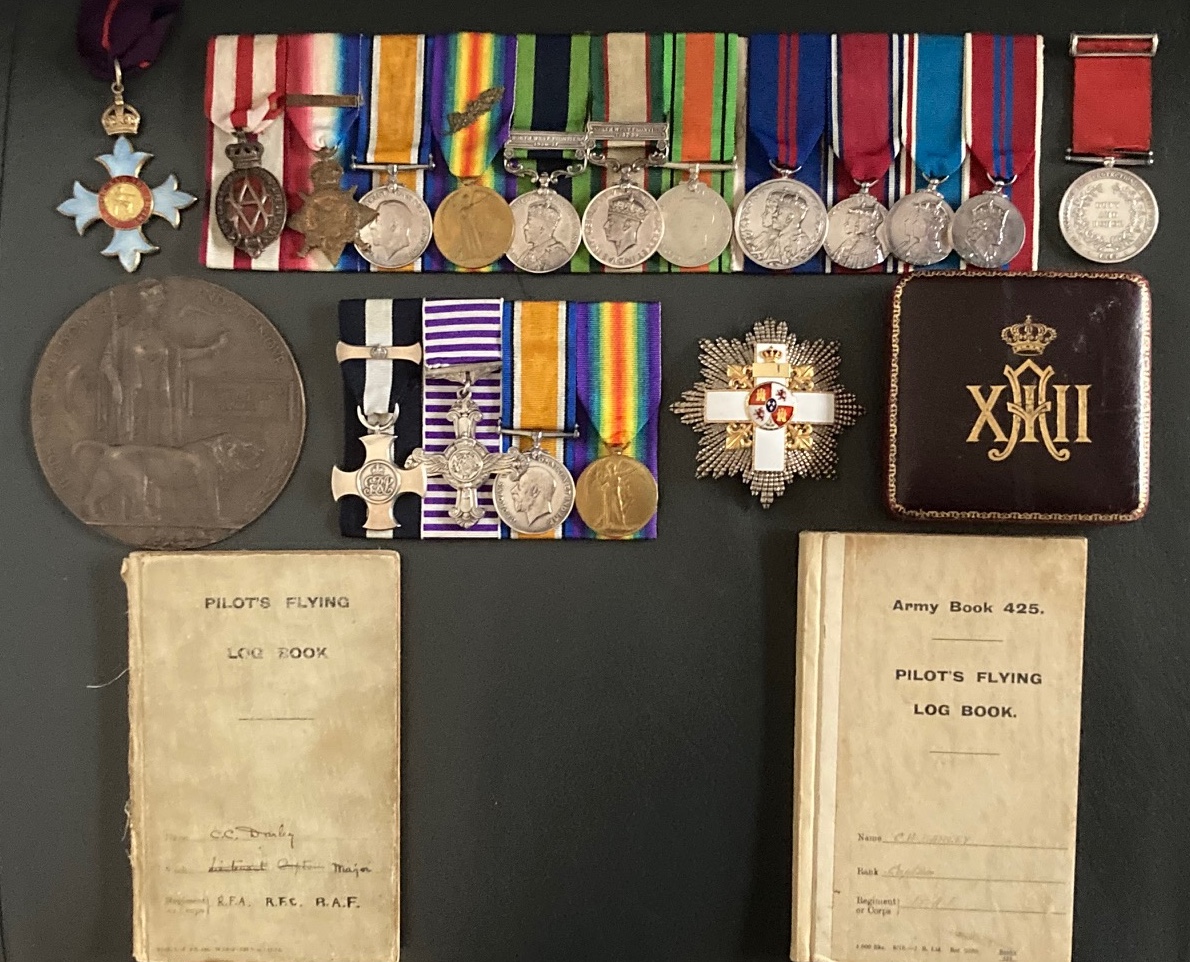
C.B.E. (Military) Commander’s 1st type neck badge, silver-gilt and enamel , Albert Medal (Land) (PRESENTED BY HIS MAJESTY TO SQUADRON LEADER CHARLES CURTIS DARLEY, R.A.F. FOR GALLANTRY IN ENDEAVOURING TO SAVE LIFE NEAR LAKE BRACCIANO, ITALY ON THE 28th SEPT. 1919.) 1914 Star & bar (Lieut. R.F.A.) British War and Victory Medals (M.I.D. oak leaf (Capt. R.F.C.) India General Service Medal bar North West Frontier 1930-31 (W/C. R.A.F.) (Wing Commander) Geo. VI. India General Service Medal bar North West Frontier 1937-39 (A/C R.A.F.), Defence Medal, 1911 Delhi Durbar engraved (Lt. C.C. Darley, R.F.A.) 1935 Jubilee, 1937 Coronation, 1953 Coronation. Silver Medal Society for the Protection of Life from Fire. (CHARLES CURTIS DARLEY, LAKE BRACIANO, ITALY, 28 SEPT. 1919).
With original Logbook
Air Commodore C.C. Darley
Albert Medal London Gazette 25 July 1922.
“On the night of 27th September 1919, a Vickers-Vimy aeroplane, piloted by Captain Cecil Hill Darley, brother of Squadron Leader (then Flight Lieutenant) Darley, who was acting as Navigation Officer, made a forced landing by Lake Bracciano, some 20 miles North of Rome, when on a flight from England to Egypt. On the following morning, in taking off, the aeroplane failed to clear a telegraph pole and crashed, immediately bursting into flames. Squadron Leader Darley was thrown clear, but at once rushed to the blazing wreckage and displayed very conspicuous bravery and devotion in persistent, but unavailing attempts to rescue his brother, who was pinned in the pilot’s seat. His efforts to release his brother were only brought to an end by his collapse. He sustained such severe burns that he was a patient in hospital for over eighteen months.”
This was a flight from Bircham Newton, England to Cairo, Egypt, part of 166 (Bomber) Squadron rearming in 1919 with Vickers Vimys and both Darley’s were part of five aircraft flying to Egypt in September 1919, to start the Indian Postal Service, which never transpired, although four of the Vimys arrived in Egypt, but the Darley brothers crashed on the way, C.H. Darley was killed and C.C. Darley awarded the Albert Medal trying to save him.
Air Commodore C.C. Darley died before existing holders of Albert Medals could exchange them for the George Cross.
Commander of the British Empire
C.B.E. London Gazette 26 June 1931. (The only operational C.B.E. to the R.A.F. for North West Frontier, India 1930-31)
…..for valuable services in operations on the North West Frontier of India between 23 April and 12 Sept. 1930.
C.B.E. Original recommendation
“Wing Commander Darley has commanded No.1 (Indian) Wing Station during the course of the operations on the N.W. Frontier from May to September inclusive with conspicuous ability, energy and resource. I have had complete confidence in him and have always known that whatever has been ordered will be carried out if humanly possible. He has shown great judgement in conducting the operations entrusted to him.
He has proved himself a competent organiser in difficult and sudden emergencies and has administered the advanced landing grounds and aerodromes that have been used during the operations in his area with conspicuous ability. He has always remained cheerful and has maintained an excellent spirit of esprit-de-corps in all ranks under his command. I recommend him very strongly for special recognition.”
Mention in Despatches London Gazette 1st January 1916 Royal Flying Corps. Lieutenant (temporary Captain) C.C. Darley, Royal Artillery.
Original recommendation – Captain Charles Curtis Darley, 11 Squadron, R.F.C. and R.A.
“For conspicuous gallantry and devotion to duty for the last two months. Has had four successful combats in the air during the last six weeks in all of which he showed great determination.”
Air Commodore Charles C. Darley was born in Newport, Shropshire, 31 July 1890, Joined the Royal Artillery as 2.Lieutenant 23 July 1910, promoted Lieut. 23 July 1913. Served in France with 20 Battery 9 Brigade R.F.A. From 15 Oct. 1914 then as a Lieut. flying in 3 Squadron ‘Granted leave 21 Feb. 1915, not expected to re-join’ as was being sent back to the U.K. for a course of instruction in aviation to qualify as a Pilot.
First official photography from the air
On 4 Aug. 1925 Squadron Leader C.C. Darley was asked for his memories of the first W.W.1. photographic flights and use of photographs of the front area’s ever made.
‘No. 3 Squadron were working with the 4 th Corps at the time. Photography commenced (mid.) December with Lieut. Moore-Brabrazon, 2.Lieut. Campbell (afterwards killed) and myself. The first two were at No.1 Wing H.Q.’s under Lt. Col. Trenchard. Major J.N. Salmond commanded the Squadron. Campbell went up once or twice only.
At first we had one Aeroplex camera only, and the results were poor, due to fogged plates and being scratched on the film surface due to the metal plate holders. Campbell lent me his Parr-Ross camera with Mackenzie Wishart plate holders, which were much better.
I don’t think anyone else in the Squadron except myself did any photography at this time. Later Lieut. E. Powell may have taken some. I had to buy my own chemicals in Bethune, develop the slides in an emergency dark room we made up in the stables of the Chateau in which we were billeted and send them out. I had an Air Mech. who knew nothing about photography to help me. I had very little trouble with the identification of photos, except the very fogged ones. As Observer I personally took results each evening to Corps H.Q. or sometimes to Divisional H.Q. and explained them, often to the General Officer Commanding personally or sometimes to a Staff Officer.
We were continually receiving queries re enemy saps and trenches, and non Flying Officers were slow in comprehending the Aerial Photo’s, as only a small area was covered by each one – the usual photographic height being 5,000 feet when we could get to it, but many Blériot’s could not go over 4,000 feet, and some less than that. It was only when the Morane Parasol’s came that we could get over 6,000 feet.
At the end of January I made a trench map, showing all the trenches on our and the enemy sides from the La Bassee-Bethune Road South of the brickfields, including the Railway triangle to North of Neuve Chapelle almost to the Aubers Ridge, which was the limit of 3 Squadron area.
The accurate part of the map finished North of Neuve Chappelle by a farm surrounded by a moat. I never saw any photo’s from 4 Squadron and think their area was more to the North.
This I believe was the first trench map and through I made it primarily for my own use as Observer, Major Salmond took it to Indian Corps H.Q., where it excited considerable interest as showing the possibilities of aerial photography, and translating the photographs, which were meaningless to most Officers, to an intelligible map. In the first week of February, a copy of that map was taken at once to Corps H.Q. & we received orders to photograph the whole line from La Bassee canal to North of Neuve Chapelle, and I kept the trench map corrected and up to date from these photo’s.
I did most if not all the photography myself, but they were developed at the Wing. In the second week Feb. I was ordered to take photo’s of the Brickfields and railway triangle South of the La Basseecanal, as the British and French were to make a combined attack.
It so happened that the air was clear and I got the two best results that had been obtained (still used in lectures in 1918) and had to go with Colonel Trenchard & Major Salmond to explain these to a combined conference of French & British Generals at a village near Bethune, General Munro was there. These photo’s showed a new long German sap unknown to the French, and, I was told, completely altered the plan of attack………
Most of this photography was done with Lieut. Wadham, G. Pretyman and H. Blackburn as Pilot.
From his original letter (in paperwork) to his father & mother 21 Jan. 1915 ‘I have been very busy of late taking photographs of trenches & making maps from them – got specially thanked by G.O.C. 1st. Army. Aerial photography has a great future, it is only just starting but the results are extraordinary.’
Darley received his Royal Aero Club of Great Britain Royal Aero Club Aviators’ Certificate (No. 592) at The Bristol School, Brooklands on a Bristol Biplane 15 Aug. 1913. Over-seas again with the R.F.C. 30 April 1915 joining 11 Squadron.
With Immelman
On the morning of 26 Oct. 1915 Vickers F.B.5 ‘Gunbus’ from 11 Squadron took off armed with a Lewis gun and a revolver on a reconnaissance patrol from Cambrai and Peronne The Squadron was in the midst of transferring to a new landing ground and ‘C’ Flight Commander C.C. Darley was flying with the partially trained 2.Lieut. R.J. Slade as his Observer. The F.B.5 crossed the lines three miles South of Arras. Unbeknown to the crew they were being stalked by Ltn. d R Max Immelmann of Feldflieger Abtellung 62, flying a Fokker Eindecker fighter equipped with a revolutionary synchronised machine gun that fired through the arc of the propeller. Immelmann in “The Eagle of Lille” recalls the fight ‘I took off at 9.30am on 26 Oct. I had just climbed to 3,500 when I saw an enemy airman fly over the lines by Arras and make for Cambrai. I let him fly on Eastward for a while. Then I took up the pursuit, hiding behind his tail all the time. I followed him for a quarter of an hour in this fashion. My fingers were itching to shoot, but I controlled myself and withheld my fire until I was within 60 metres of him. I could plainly see the observer in the front seat peering out downward.
Knack-knack-knack…went my gun. Fifty rounds, and then a long flame shot out of his engine. Another 50 rounds at the pilot. Now his fate was sealed. He went down in wide spirals to land.
Almost every bullet of my first series went home. Elevator, rudder, wings, engine, tank and control wires were shot up. The pilot (Captain. C. Dalgy (sic,)) had a bullet in the right arm. I also shot his right thumb away. The machine had received 40 hits. The observer (Lieutenant R.J. Slade) was unwounded. His machine gun was in perfect working order, but he had not fired a single shot. So complete was the surprise I sprung on him.’
Darley managed to land his crippled ‘pusher’ near Ecoust, St. Mein behind the German Lines.
Max Immelmann the Pour Le Merite holder, this his 5 th Victory landing behind enemy lines in Belgium and was made a Prisoner of War, Darley being repatriated in Sept. 1917 through Switzerland as the wounds received when shot down lost him the use of his right arm having been promoted to Capt. 23 July 1916 while a P.O.W.
On the 27 th ‘German wireless reports a French Biplane with English Officers brought down in aerial fight, Officers taken prisoner. Message dropped in X French Army Lt. Slade not wounded, Lt. Darley shot in forearm and thumb.’
From Lieut. Slade’s letter – written 13 Nov. 1915 – received 30 Nov. 1915.
Ltn. Immelmann of the German Flying Corps came up behind us, and opened fire with his machine gun. Unluckily for us his first shot hit our petrol tank and flames burst out behind. Darley shoved her nose down and the German Aviator followed us down, keeping behind and pouring lead into us all the time. Fortunately the tank did not explode, cannot understand why, but went out. Darley had one bullet through his arm, one took the tip of his finger off, another smashed his thumb to smithereens. I amputated it with my penknife. I was untouched except my clothing. Could not set machine on fire as all petrol had come out, and my efforts on the wing only ended in the waste of a box of matches owing to high wind. Darley did a stunt landing with only his left hand. Extraordinarily plucky I call it – and saved my life. We were on a French machine, and that if we had been on a British, the armour plating would have saved us.
Lieut. Immelmann descended too, he is a gentleman, and if we ever capture him I hope he will be treated the same. I hope the Major has fully graded me as I am afraid shall be here for some time, and I have tried to do my “petit peu” during the three months I have been out. Darley is in hospital, and was keeping up his spirits despite his wounds. I’d willingly go through it all again with him. Love to the old Squadron, and I hope to see you all again soon.”
Squadron Leader Darley was injured again in a take off crash of a Vickers-Vimy aircraft piloted by his brother in which he was acting as Navigation Officer, near Lake Bracciano, Italy on 28 th September 1919. Squadron Leader Darley was thrown clear of the burning plane but re-entered it in a vain attempt to save the life of his unconscious brother. He suffered severe burn injuries, even to the extent of losing his eyelids and eyebrows. He was hospitalised for 13 months. Received extensive plastic surgery and had received at least 60 general anaesthetics by 1921. After this he was Commandant of R.A.F. Physical Training at Uxbridge and other sites in India and England. While serving on the North West Frontier in 1930-1931 he was appointed a Commander of the Order of the British Empire. Still flying in 1938, he received a injury to his head and left active service due to it. Air Commodore 1 July 1938. On the outbreak of W.W.2. in September 1939 Darley was hired as a civilian employee at the Air Ministry and finally retired in 1959 after service with the Airfields Control Board. Died 10 June 1962.
Original logbook, pictures, Albert Medal recommendations originally for an A.F.C., newspaper cuttings, letter, re awards to inventors, telegrams, 1915 letter from Darley 3 Squadron, ‘missing’ letter to family from 11 Squadron, detailed typed 23 page letter to his mother from date shot down with P.O.W. detail, hospital treatment etc from Switzerland 1916, handwritten statement of crash at Lake Bracciano 1919, Lieut. Slade’s letter his Observer in 1915 and much more. Copy Recommendations for awards, narrative of events on N.W.F. 1930, R.A.F. War Diary 1938, ‘The Times’ obituary, altogether a comprehensive research archive.
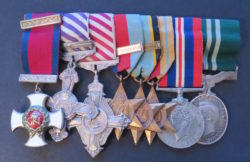
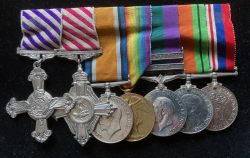
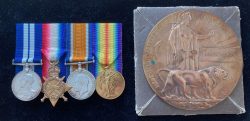
Distinguished Service Cross, (GV.). and second award bar, Distinguished Flying Cross, GV) , British War and Victory Medals (Capt, R.A.F.) Spain Order of Military Merit 2nd Class Breast Star. Memorial Plaque Cecil Hill Darley). Order of Military Merit in case of issue.
With original logbook
D.S.C. London Gazette 11 August 1917
“For conspicuous skill and gallantry on the night of the 2 July 1917. One of his engines having seized whilst he was over Bruges, he dropped his bombs on the objective and managed to fly his machine home on one engine and effected a safe landing on his aerodrome.”
Original recommendation states from ‘Air Station, Dunkirk.’
Bar to D.S.C.
London Gazette 17 April 1918.
“For zeal and determination in carrying out numerous night bombing raid on enemy aerodromes and docks etc. On the night of February 18-19th, he carried out two attacks on the St. Dennis Westrem aerodrome.”
Distinguished Flying Cross
D.F.C. London Gazette 2 July 1918. “An Officer with a fine record of gallantry to his credit. During the past two years he has been flying in active operations, twelve months of which were on night flying bombing work, being on one occasion in the air in bad weather for 7.5 hours. On several occasions he has carried out two raids on the same night and during the past months he has successfully attacked a very formidable enemy position from a height of 200 feet in the face of very intense fire.”
Original recommendation was for D.S.O., 214 Squadron, R.A.F., 65 Wing. expands
On night of 27-28 May 1918, he attacked Zeebrugge Lock Gates from a height of 200 feet in face of very heavy fire. This officer has taken part in 60 raids and has always shown an extremely fine spirit’ Note 3 June 1918 ‘get some more of his performances.’
A second recommendation 6 June 1918 now marked for a D.F.C. ”On night of 27-28 May 1918, he attacked Zeebrugge Lock Gates from a height of 200 feet in face of very heavy fire.
He has taken part in many raids and has been flying under war conditions for over 2 years.
He has been employed on night bombing with Handley-Page machines for a year, previous to which he did excellent work with Caudron machines on day bombing raids and with Short machines on night bombing raids. On one occasion, on a Short machine, he was in the air for 7.5 hours in bad weather.
Since being awarded the Bar to his D.S.C. He has carried out six raids, which include another attempt to bomb the Lock Gates at Zeebrugge from a low altitude. On this occasion he only broke off the attack when compelled to return owing to a boiling engine.
He has on several occasions carried out two raids on the same night, thereby setting a fine example to the junior Pilots and Observers of his Squadron.’
Spanish Cross of Military Merit
Order of Military Merit 2 nd Class Breast Star, Spain. “For the attempt to make a record non-stop flight from London (Manston) to Madrid. The weather prevented a non-stop flight, however after several weeks in Spain the reverse course was attempted. Shortly after take-off whilst over the Bay of Biscay, the machine started to disintegrate at 5,000 feet and crashed into the sea, the crew being rescued by a Spanish fishing vessel.”
Two Original Award Certificates for Spain Order of Military Merit 2ndClass Breast Star –Cecil Hill Darley. Dated 1920.
Captain Cecil Hill Darley was born 11 March 1889 at Newport, Salop, the first son of Captain Charles E. and his wife Emily Darley educated Dulwich College & Liverpool University. Trained as a Pilot in Canada taking his Royal Aero Club of Great Britain Aviators’ Certificate (No. 1718) at the Curtiss School, Toronto, Canada on a Curtiss Biplane 1 Sept. 1915. Joined the R.N.A.S. 1 Sept. 1915 as a bomber Pilot engaging in more night-bombing raids in France than any other Pilot. After W.W.1. transferred to the R.A.F. commanding a mission to Spain in 1919. Later that year, then a Major he lost his life in a crash of his Vickers-Vimy twin engined aeroplane when attempting a take-off from a field near Lake Bracciano, Italy. This was part of 166 (Bomber) Squadron rearmed in 1919 with Vickers Vimys and both Darley’s were part of five aircraft flying to Egypt in September 1919, to start the Indian Postal Service, which never transpired, although four of the Vimys arrived in Egypt, the Darley brothers crashed on the way, C.H. Darley was killed and C.C. Darley awarded the Albert Medal trying to save him.
1920 Obituary
Cecil Hill Darley after graduating at Liverpool University as a Bachelor of Engineering, was employed by Messrs. Holme and King, who had contracted to put up a large number of bridges in the neighbourhood of Coventry, for the L.& N.W. Railway.
He was elected a Student of the Liverpool Engineering Society on 22nd March, 1911, and was an Associate Member of the Institution of Civil Engineers.
After finishing the L.& N.W. Railway work he went to Canada early in 1914 and became an assistant engineer, constructing filter beds for the Montreal waterworks.
When war broke out he was amongst the first thirty volunteers for flying. These volunteers went to Toronto and at their own expense took their flying certificates on Lake Ontario.
In the summer of 1915, Cecil Darley was given a Commission in the R.N.A.S., and appointed to be a pilot of a B.E.2c at Eastchurch, England.
In 1916 he was promoted and sent across to France. During his two and a half years there he made over 70 night raids, bombing enemy’s posts and lines. For bringing his machine safely back after an eight-hour flight at sea, in a fog all night, he was awarded the D.S.C., and to this was added the Bar, for bravery and successful bombing in face of the enemy.
After the famous naval raid on Zeebrugge, it was necessary to blow up the lock gates across the canal at Zeebrugge. For this work Cecil Darley volunteered and successfully accomplished the job about midnight, 26th (27-28) May, 1918. He flew a Handley-Page bombing machine, and amidst star shells and a hail of bullets he descended to 200 feet over the lock gates, and with the help of his gun layers, bombed the gates with excellent results, subsequent photos showing that the lock gates had been utterly wrecked. For this he was awarded the D.F.C. and promoted to Major.
In May, 1919, the Government chose Major C. H. Darley to take the new super Handley-Page (then the biggest machine in the world) over the Pyrenees to Madrid. Here, with his crew of six men, he stayed three weeks, giving demonstrations and flights to members of the Spanish Government. The Spanish King and Queen entrusted him with letters to the King and Queen of England, and on his arrival in London he delivered these in person.
In August, 1919, Major C. H. Darley was offered a permanent commission as Captain, and the following month the Air Ministry sent him, in command of the squadron of Vickers-Vimy machines, to fly from Bircham Newton to Cairo, Egypt. He took with him as navigator, his brother, Major C.C. Curtis Darley, R.A.F., and a mechanic. In two days they flew from Bircham Newton to the South of France, but the third day engine trouble and head winds delayed them and they could not reach Rome owing to darkness, so made a forced landing at the seaplane base at Lake Bracciano. The next morning he essayed to start over the heavy ground but the machine failed to rise and the tip of her wing caught the telegraph wires which crossed the ridge of rising ground. The machine turned over and the reserve petrol tank, immediately over the Pilot’s head, burst into flames and rolled down the hill. Major Curtis Darley and the mechanic were thrown clear but Major C. H. Darley was pinned underneath. Major Curtis Darley went straight back into the petrol flames to save his brother, but was unable to free him, having lost (the use of) his right hand in the war; again he got underneath the machine but was blinded and fearfully burnt in this second attempt to save his brother, and has lain in hospital ever since.
Major Cecil Darley was buried with full military honours in Rome. In addition to the Distinguished Service Cross and Distinguished Flying Cross already mentioned, Major Cecil Hill Darley had conferred on him, by the King of Spain, the Cross of Military Merit for his bravery in the cause of aviation.
Original Logbook. Two Original Award Certificate for Spain Order of Military Merit 2nd Class Breast Star –Cecil Hill Darley. Dated 1920. Copy pictures of Handley Page 0/400 bombers he flew or in the Squadron and a large file of research,