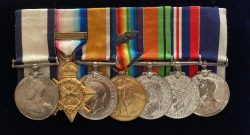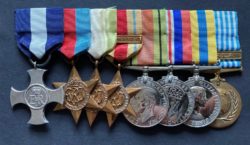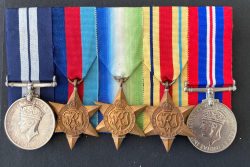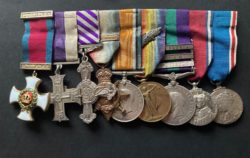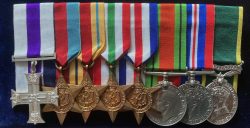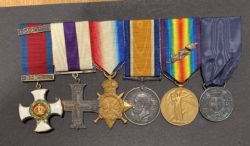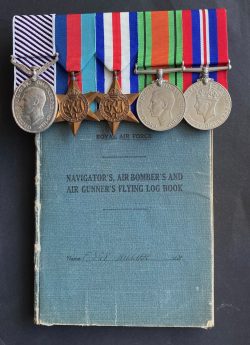
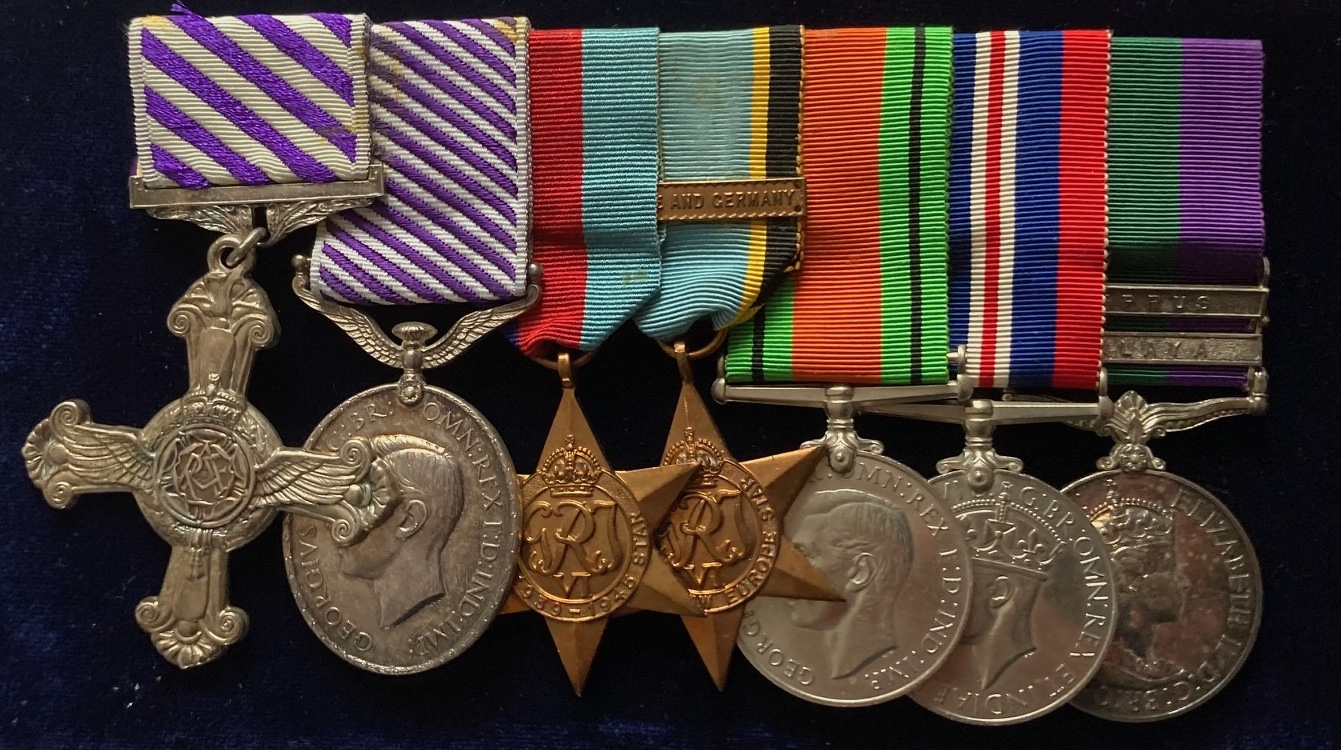
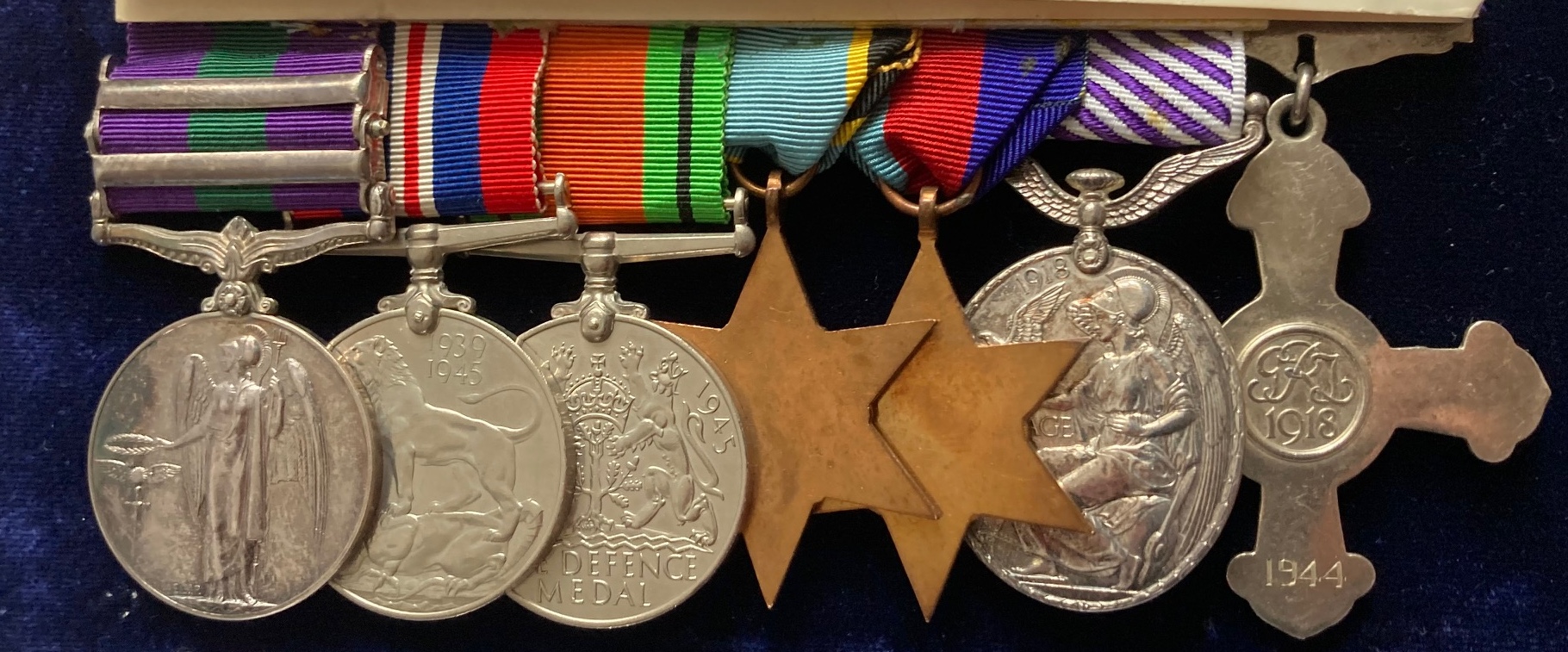
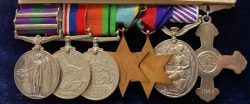
A good Second World War ‘1944’ D.F.C., ‘1943’ D.F.M. group of seven awarded to Halifax pilot Flight Lieutenant. His DFM awarded in main for when aircraft was shot down into the sea in the vicinity of the Dutch coast and he and his crew were rescued 3 days later by an Air Sea Rescue Launch after undergoing extreme hardships. The rescue was completed under fire from 3 enemy ‘E’ boats.. His DFC in part for pressing home on attack on Dusseldorf whilst coned by searchlights and partly for a attack on Karlsruhe when pressing home his attack despite losing height doe to severe icing.
£4,850.00
Distinguished Flying Cross, (GV1)., reverse dated ‘1944’;,Distinguished Flying Medal, (GV1. F/Sgt. R.A.F.); 1939-45 Star, Air Crew Europe Star, clasp, France and Germany, Defence Medal, War Medal, G.S.M. , 2 clasps, Malaya, Cyprus (Fg. Off. R.A.F.) l
Flight Lieutenant L. J. Hampton, R.A.F.
With a copy of an extract from the Manchester newspaper containing a photo of the recipient and regarding his award and his being shot down.
D.F.C. London Gazette 14 November 1944.
The original recommendation states:
‘Flight Lieutenant Hampton has completed two tours of operational duty. He has shown himself a capable captain of aircraft and a skilful and resolute pilot. He has also acted as deputy flight commander. On one occasion he was captain of an aircraft detailed to attack Dusseldorf in April, 1944. His bomber was illuminated by searchlights at the commencement of the bombing run. With great determination, this officer pressed home the attack and successfully bombed the target. Another time, during a sortie to Karlsruhe his aircraft lost height to 12,000 feet, before reaching the target area, owing to severe icing. Despite difficulties, he continued his mission which was successfully completed.’
D.F.M. London Gazette 14 May 1943.
The original recommendation states:
‘Whilst returning from a raid on Essen recently, Flight Sergeant Hampton’s aircraft was shot down into the sea in the vicinity of the Dutch coast. He and his crew were rescued three days later by an Air/Sea rescue launch after undergoing extreme hardships. A rescue was completed under fire from three enemy E-boats. In spite of this grim ordeal, this Captain has continued to operate with undiminished ardour. During an attack on Kiel in October, 1942, his aircraft was illuminated by searchlights and repeatedly hit by gunfire. In spite of this, Flight Sergeant Hampton dived from 14,000 to 6,000 feet to bomb and secure outstanding photographs. Through his devotion to duty and unflagging enthusiasm for operations, Flight Sergeant Hampton has become one of the outstanding Captains of this squadron and he is strongly recommended for the award of the Distinguished Flying Medal.
Remarks by Station Commander: This N.C.O. is a fine leader and determined Captain. Despite his experiences when forced down in the sea, he has continued to display unswerving determination to get on with the job. I recommend him for the award of the Distinguished Flying Medal.
Remarks by AOC: This Captain has completed a fine operational tour and has been posted for training duties with a heavy conversion unit. Very strongly recommended for the award of the Distinguished Flying Medal.’
Leslie Jones Hampton was born in June 1916, and after training was posted as a Sergeant pilot for operational service with 10 Squadron (Halfaxes) from Melbourne. He flew in two operational tours with the Squadron, between July 1942 – March 1943, and January 1944 – July 1944. The raid to Essen was not the only eventful trip during his first tour, Hampton’s aircraft had an engine failure in the vicinity of Genoa (7 November 1942) and was forced to abandon the mission – jettisoning bombs near Skegness and crash landing, leading to a burnt out aircraft. Further raids on heavily defended German targets followed before being commissioned at the end of his tour in March 1943.
Hampton was posted as an instructor to No. 1663 Heavy Conversion Unit, Rufforth, in April 1943. As Flying Officer in September 1943, he returned to operations with his old squadron, still operating out of Melbourne, in January 1944. Following his his second tour, Hampton was posted for Instructional Duties at No. 1652 C.U. in September 1944. Flight Lieutenant in March 1945, he retired in June 1966.