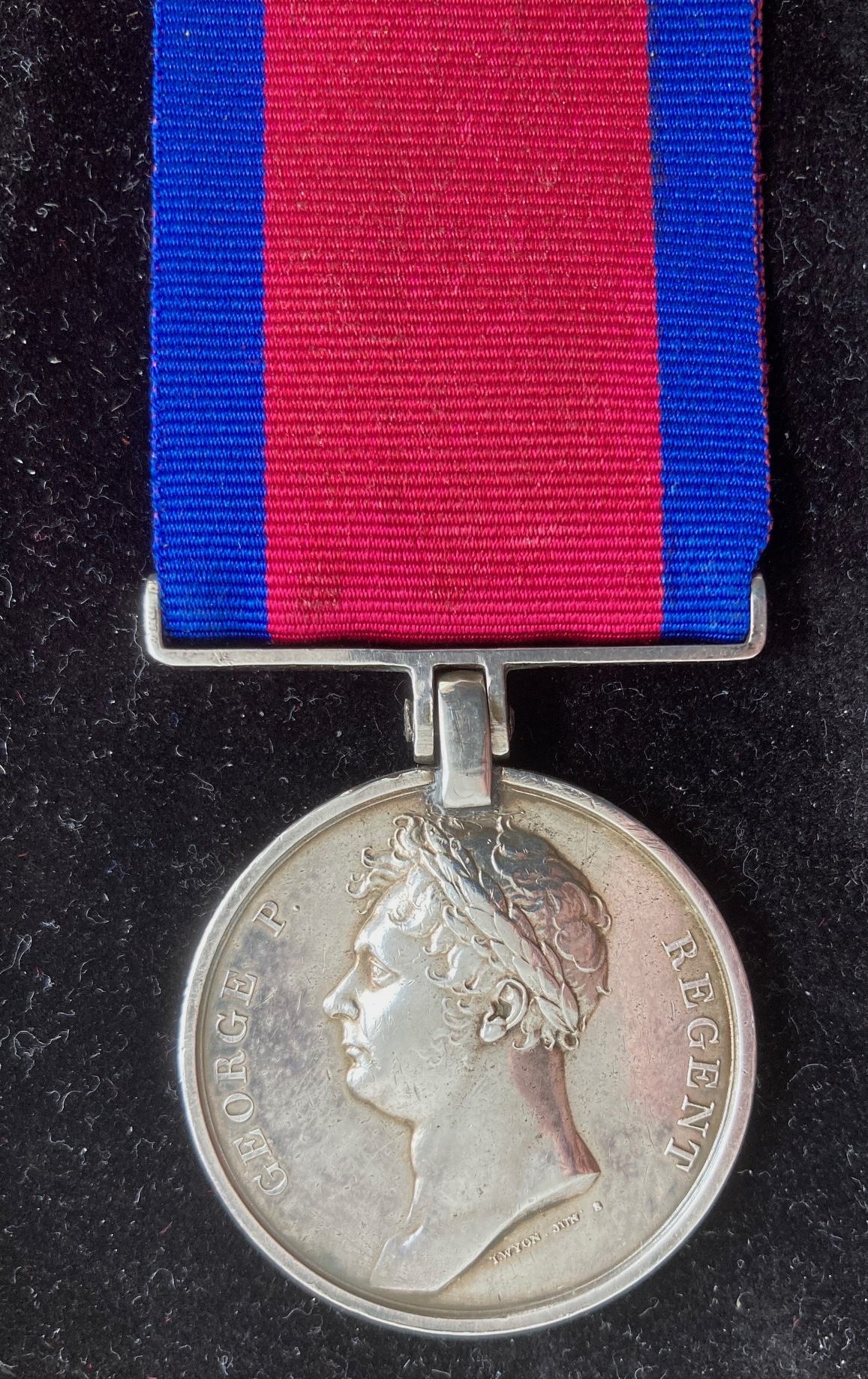
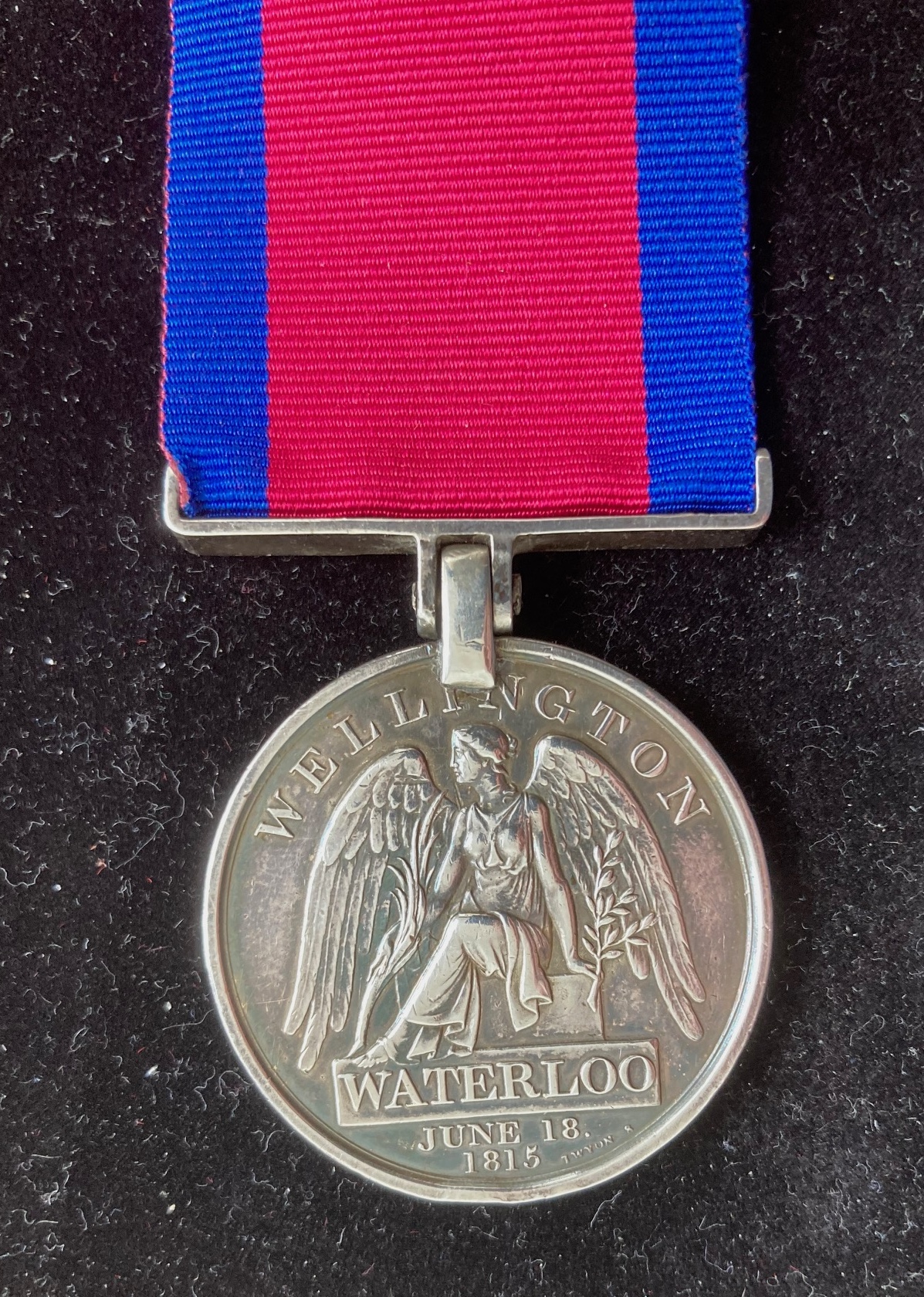
Waterloo , 79th Regiment . A fine Light Company Man, thrice wounded , severely wounded in the leg at Fuentes D’onor, in the arm at Pampeluna and the leg at Waterloo. had served with the Caithness Legion from 1794 which was sent for service in Ireland from that date and saw action at the Battle of the Big Cross during the Rebellion
£3,600.00
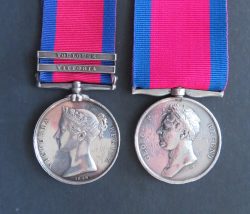
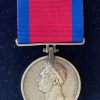
Waterloo
George Moore, 1st Batt. 79th Regiment. Foot.
Silver clip and straight bar suspension.
With copy discharge papers and musters (Moore on the medal roll – Moor on discharge papers, the only George Moor/Moore)
Discharge papers state , b. c. 1778 Wilts. Caithness Legion, November 1794, attested 79th at Kilkenny, May 1800
‘Conduct very good, that he served in Egypt, Copenhagen, Flushing, Portugal, Spain in the years 1808, 1810, 1811, 1812, 1813, 1814 and in Flanders and France, 1815, 1816, 1817, was severely wounded in the leg at Fuentes D’onor, in the arm at Pampeluna and the leg at Waterloo.’
The Caithness Legion was raised by Sir Benjamin Dunbar of Hempriggs in 1794 When embodied, it was moved to Ireland, They were instrumental in defeating local United Irishmen rebels at the Battle of the Big Cross near Clonakilty, County Cork, on June 19, 1798, aiding the Westmeath Militia and securing local loyalist control. The Big Cross was the only major engagement in County Cork, assisting the Westmeath Militia, who were being hard-pressed by rebel forces under Tadhg an Asna. The regiment’s arrival turned the tide against the rebels, resulting in around 100 Irish deaths and a swift crackdown in the area, notes the Dúchas Clonakilty Heritage Facebook post.
The regiment was praised for its “cool, steady conduct” by leadership during the conflict.
In 1797 the regiment, with the exception of about 50 men, had volunteered their services to any part of Europe. In the summer of 1800, 200 men volunteered into the 79th and 92nd regiments. As an ensign was to be appointed to every 50 men who should volunteer from the fencible regiments, four officers from the Caithness Highlanders obtained commissions in the 79th and 92nd of the line.
Moore accordingly saw service with the 79th from July 1800
Egypt 1800-1801
The 79th was under the command of Major-General Craddock. The regiment participated in the landing at Aboukir Bay (March 1801) and the Battle of Rhamanich. Cairo and Alexandria: The 79th played a key role in the final stages of the campaign, including taking possession of the “Gate of the Pyramids” in Cairo and the subsequent surrender of French forces.
After the surrender of the French forces in Cairo, the regiment stayed until the surrender of Alexandria, departing Egypt for Minorca in October 1801.
1st May 1811 (At Fuentes d Onoro)
On the first day of fighting only the Light company of 1/79th were engaged in the village buildings with a large number of other Light companies and, in the violent attacks and counter-attacks in street fighting the company commander Captain William Imlach was killed and two officers wounded along with 22 other ranks killed and wounded
In the heavy fighting of the 3rd the Colonel , Cameron, was felled from his horse mortally wounded. At that point a charge was ordered by Brigadier-General Mackinnon, and the enemy was driven out of the village with great slaughter. The post was maintained until the evening,
Besides the mortally wounded. Lt.-Colonel Cameron, , the 79th had 11 officers killed and wounded and 144 others ranks with about 100 missing, many of whom were afterwards reported as killed. (Numbers include the Light Company losses of the 1st.)
Served at Waterloo with the Light Company. Cruickshank of the 79th (Light) later wrote (Siborne p.360).
‘When the 79th were deploying into line at the commencement of the Action (they having been previously in column) the Light Company, to which I then belonged,were ordered out and extended. On our reaching the thrown out hedge (or nearly so), where the Guns were stationed, we passed through the Belgian valley. Infantry, who were retiring, and pushed down the slope in front of the hedge into the valley, where we were for some time engaged with the French skirmishers’
Moore was discharged in 1818 with 25 years service (including 2 years for Waterloo)
An especially fine and well conditioned medal.