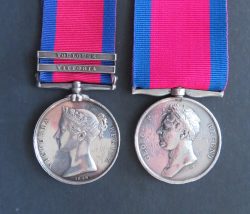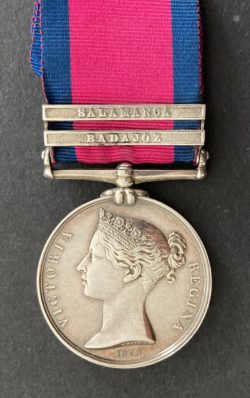
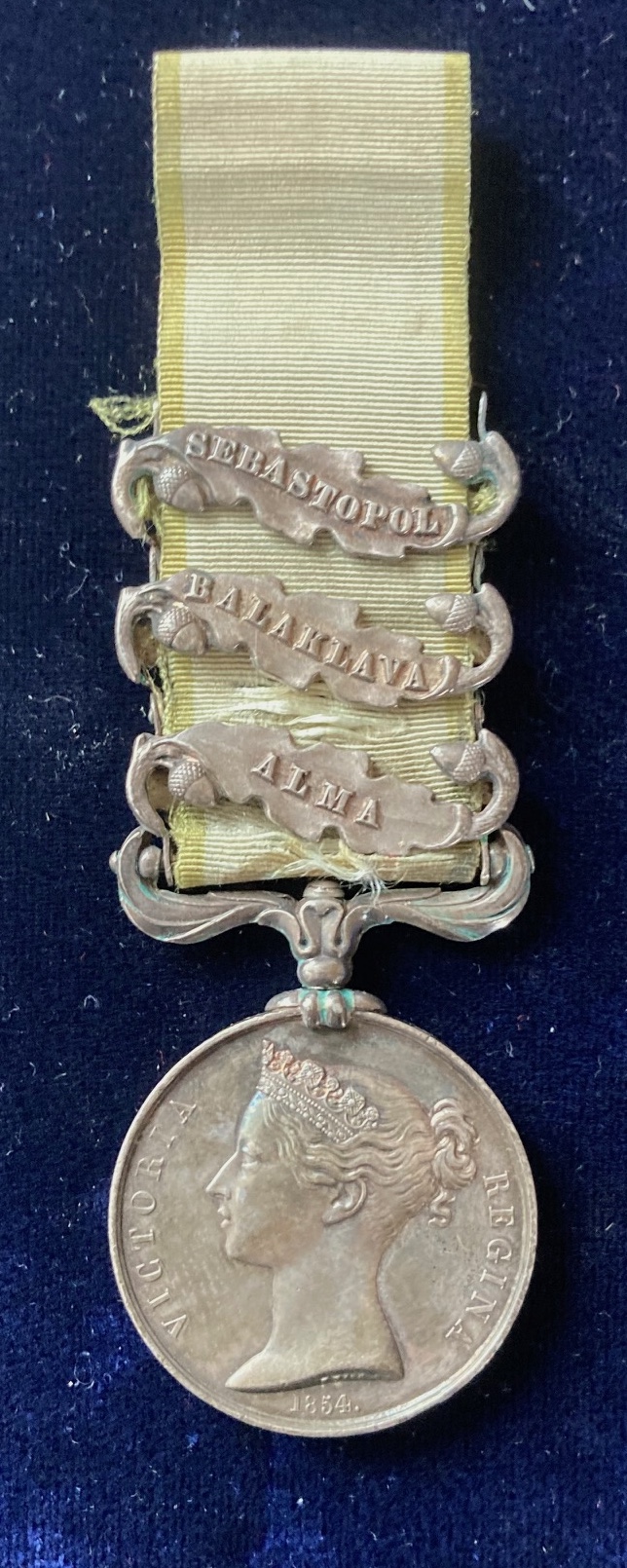
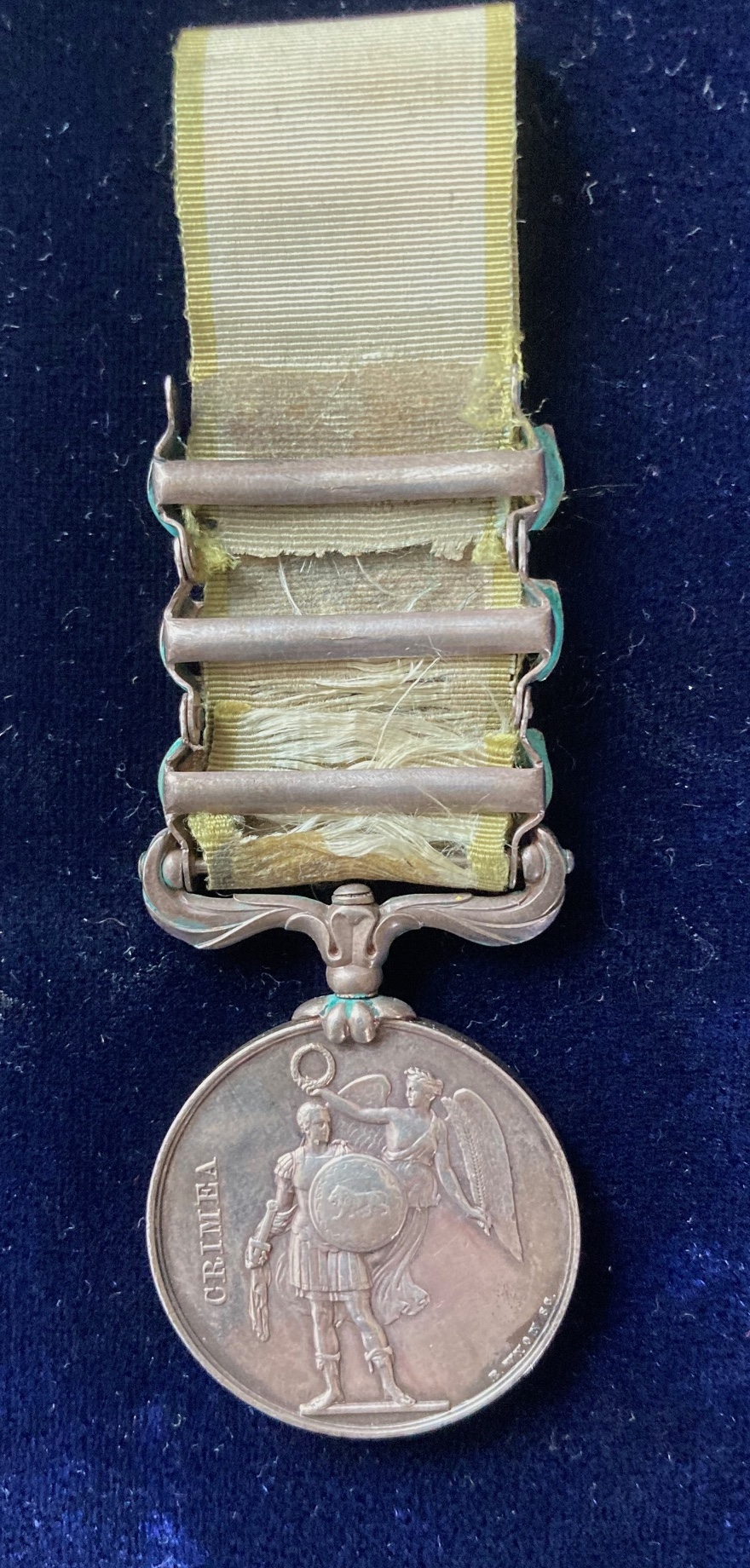
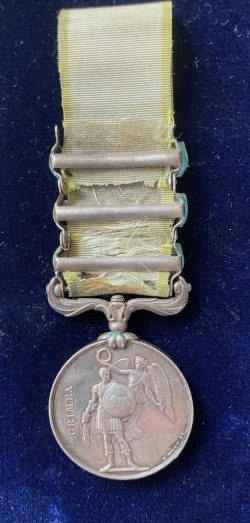
Crimea, 3 clasps, Alma, Balaklava, Sebastopol
J. Fitzgibbon, 8th Dragoons
Officially impressed . A particularly fine medal of long provenance to the 8th (Royal Irish) Hussars. Nicely conditioned with good old toning and original ribbon
Prov. Sotheby’s, 1881.Glendining’s, September 1919, March 1927, June 1929, and October 1937.
John Fitzgibbon was born in Limerick and enlisted for the 8th Dragoons on 23 June 1847. A harness-maker prior to enlistment, he embarked for the Crimea aboard the transport Echunga on 25 May 1854. He is confirmed by every source as having been killed in the charge of the Light Brigade on 25 October 1854. Lieutenant-Colonel Sherwell led them into the Charge but had forbidden two soldiers to carry their swords for they had ‘…disgraced the regiment by smoking in the presence of the enemy’.
Described by Lieutenant The Honourable S. Calthorpe, who was an Aide- de-Camp for the unit:
‘The pace of our Cavalry increased every moment, until they went thundering along the valley, making the ground tremble beneath them. On they went headlong to death, disregarding aught but the object of their attack. At length they arrived at the guns, their numbers sadly thinned, but the few that remained made fearful havoc amongst the enemy’s artillery.’
‘Colonel Shewell (commanding 8th) then led his men through the battery and halted on the other side, enquiring, like Lord George Paget,’Where is Lord Cardigan?’ For about three minutes the 8th Hussars waited, then on the skyline appeared lances. The fifteen men of the 17th Lancers, who with the few survivors of the 13th Light Dragoons had charged out of the battery before the second line attacked, were now retreating, with a large Russian force in pursuit. Colonel Mayow, their leader, galloped up to Colonel Shewell. ‘Where is Lord Cardigan?’ he asked. At that moment Colonel Shewell turned his head and saw that he, too, was not only menaced in front: in his rear a large force of Russian cavalry had suddenly come up, and was preparing to cut off his retreat and the retreat of any other survivors of the Light Brigade who might still be alive beyond the guns. A stern, pious man, by no means popular with his troops,. Colonel Shewell had the harsh courage of Cromwell’s Bible soldiers. Assuming command, he wheeled the little force into line and gave the order to charge. He himself, discarding his sword – he was a poor swordsman – gripped his reins in both hands, put down his head and rushed like a thunderbolt at the Russian commanding officer. The Russian stood his ground, but his horse flinched. Shewell burst through the gap and was carried through the ranks to the other side. Riding for their lives, his seventy-odd troopers dashed after him. The Russians were thrown into confusion and withdrew, and the way was clear.
But what was to be done next? Colonel Shewell paused. No supports were coming up, Lord Cardigan was not to be seen; there was nothing for it but retreat, and, just ahead of Lord George Paget and Colonel Douglas with the 4th Light Dragoons and the 11th Hussars, the other survivors of the Light Brigade began slowly and painfully to trail back up the valley.’
Though an Irish Regiment there were two Irish officers and nine-four other ranks served in the Crimea. One Irish officer and twenty-seven Irish other ranks actually charged with the brigade, of whom eight were killed, five wounded and two taken prisoner, one of whom was also wounded. The two Irish officers who served in the 8th in the Crimea were Captain Lord Killeen, later tenth Earl of Fingall, who did not rejoin the Regiment until after Balaklava, and coincidentally Lieut. John Viscount Fitzgibbon, who was killed in the charge. John Viscount Fitzgibbon was the son of the third Earl of Clare and a grandson of ‘Black Jack’ Fitzgibbon, the controversial Lord Chancellor of Ireland at the time of the Union. Total casualties for the regiment were some forty-seven, killed wounded and prisoner, most of the latter wounded. Numbers of the regiment engaged vary but estimated between 110 and 130 from the already depleted number 323 officers and men that had landed at Constantinople