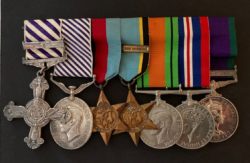
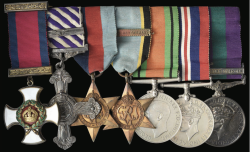
A ‘100’ Club’ Path Finder Force’ Pilot D.S.O. D.F.C. and Bar group to include GSM Palestine 1945-48 Squadron Leader of No. 109 Squadron (Path Finder Force) and No.105 Squadron, R.A.F.V.R., who completed over 100 wartime sorties over France and Germany as part of the elite ‘Oboe’ Squadrons. Having taken part in two early attacks on the German Battleships Scharnhorst and Gneisenau at Brest Harbour, he was part of the very first confirmed ‘Oboe’ operation on 20 December 1942, and earned an immediate award of the Bar to his DFC for pressing home an attack on Dusseldorf in November 1943 despite technical failure and engine trouble
£8,950.00
Out of stock
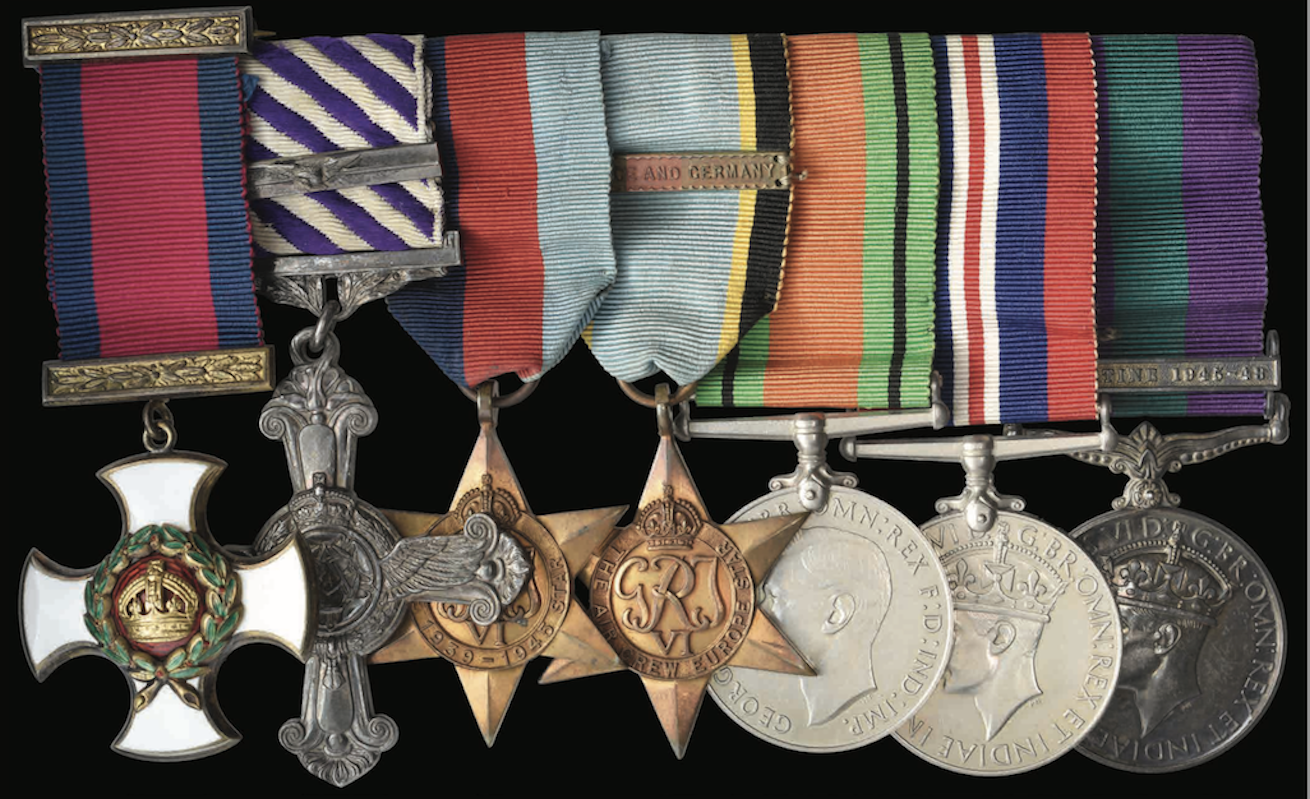
Distinguished Service Order, (GV1), silver-gilt and enamels, Distinguished Flying Cross, (GVI), reverse dated ‘1943’, with second award, dated ‘1943’ ,
1939-45 Star, Air Crew Europe Star, with clasp ‘France and Germany’ , Defence and War Medals, General Service Medal, clasp, Palestine 1945-48 (Sqn. Ldr.. R.A.F.);
Squadron Leader John Cunningham ‘Monty’ Thelwell, of No. 109 Squadron (Path Finder Force) and No.
105 Squadron, R.A.F.V.R.,
Group mounted as worn.
Extensive archive to include original D.S.O. warrant, named to the recipient, No.109 Squadron; original R.A.F. Path
Finder Force certificate for badge two ‘Postgrams’ of congratulation signed by Air Chief Marshal Arthur
‘Bomber’ Harris dated 2 December 1943 (D.F.C. – No. 105 Squadron) and 20 October 1944 (D.S.O. – No. 109 Squadron);
Buckingham Palace Investiture invitation dated 7 December 1943; two original R.A.F. cloth ‘wings’ and bronze eagle
emblem; ‘For War Service’ lapel badge; various military badges and buttons , handwritten letter from Harry Scott, his regular Navigator in the latter years of
the war, original WW2 medal transmission slip; USAREUR Intelligence and Military Police School, Special Weapons
Division Certificate, Birth and Death Certificates, a quantity of original and copied wartime photographs, and other related
documentation.
His two pilot’s flying logbooks were officially donated to the Imperial War Museum in 1988 by
the recipient’s brother and the official donation & correspondence are included, and I.W.M. summary)
D.S.O.: London Gazette: 23 December, 1943 – ‘in recognition of gallantry displayed in flying operations against the enemy’
Recommendation states
Squadron Leader Thelwell has completed more than 100 sorties. In the course of his assignments he has
attacked a wide range of important and well defended targets and his successes are an excellent testimony to his great skill, courage
and tenacity. He has rendered much devoted and loyal service.’)
D.F.C.: London Gazette: 14 May 1943 – ‘the King has been graciously pleased to approve the following awards’
Whilst the official PRO recommendation is not to hand (This, as published in ‘The Magazine of the Westminster Bank Staff’, Summer 1943).
‘…Between February and June 1941 he completed numerous sorties against heavily defended targets in Occupied France, and also two
sorties against the German warships when at Brest. Since December 1942 he has participated in a number of sorties, the majority of
which have been against industrial targets in Western Germany. Throughout all operations he has displayed the greatest determination
and courage.’
Bar to D.F.C.: London Gazette: 14 December 1943 – ‘in recognition of gallantry displayed in flying operations against the enemy’
Citation in the Gazette states
‘Flight Lieutenant Thelwell is a skillful and resolute captain who has completed very many successful
sorties. One night in November, 1943, he piloted an aircraft detailed to attack Dusseldorf. Early on the outward flight a technical failure
caused engine trouble. In spite of this, Flight Lieutenant Thelwell went on to the target and, in the face of heavy opposition, executed a
successful attack. He displayed skill and determination of a high order.’
Squadron Leader John Cunningham ‘Monty’ Thelwell was born on 19 March 1913 at Harrogate, North Yorkshire, the son of George
Tatton Thelwell, and Ethel Jane Thelwell (née Cunningham).
Educated at Bridlington School, he followed his father into the banking profession, passing his Part I Examination with the Institute of Bankers on 1 October 1937. After the
outbreak of hostilities in WW2, however, he ‘joined up’ for military service with the R.A.F.V.R. and began a short period of flying training
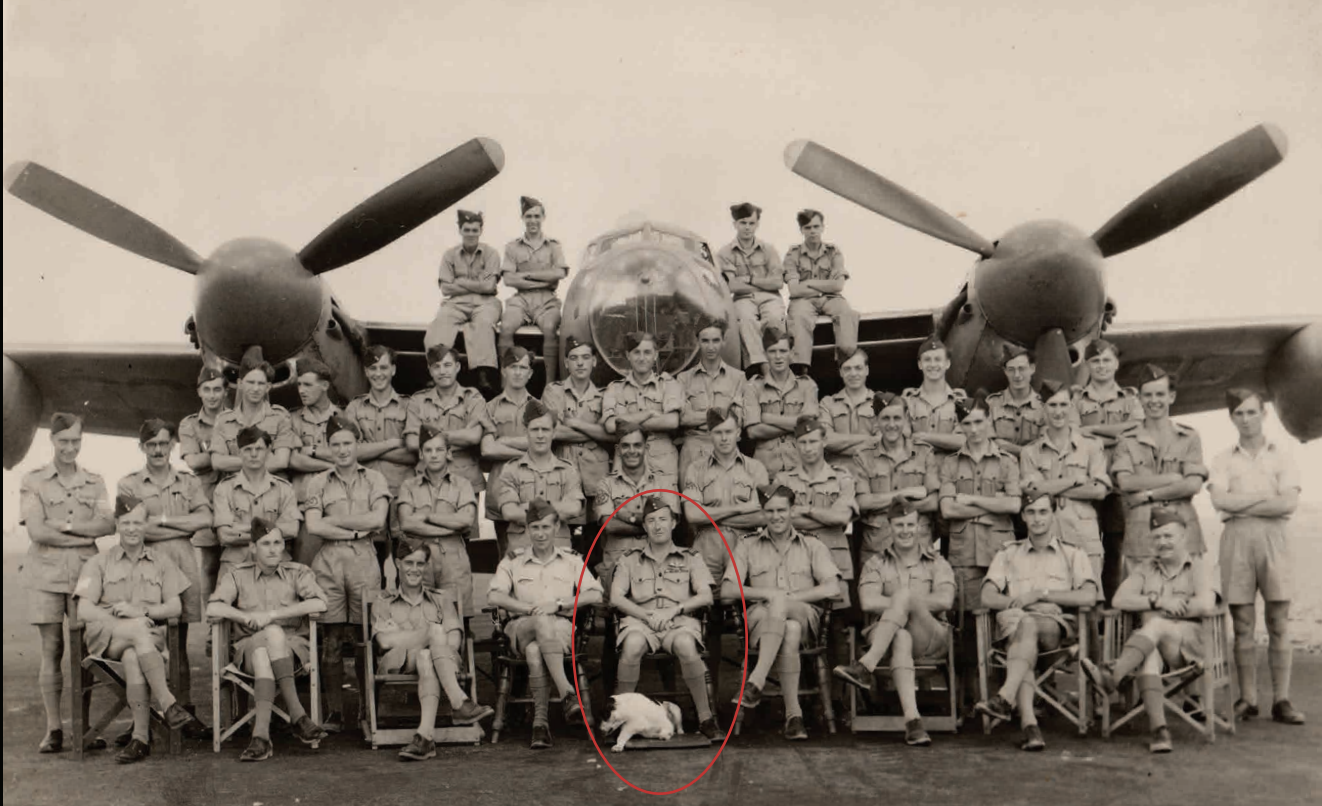
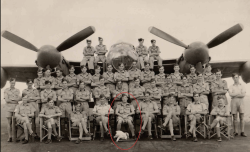
between August 1940 and January 1941. After this training he began operational service with No. 109 Squadron, Path Finder Force, based at Little Staughton, and flying Mosquito
aircraft, as confirmed by the summary of his logbook details provided by the I.W.M. He completed some 40 sorties against targets in France
and Germany during his first period of service with No. 109 Squadron, including two attacks upon the German warships Scharnhorst
and Gneisenau in Brest Harbour in 1941. During this period, N0.109 Squadron was chosen to be used in the development of a new,
sophisticated radio-based bomb-aiming & navigation system called ‘Oboe’, which was able to help bomber aircraft to ‘pinpoint’ enemy
targets regardless of weather and visibility, dropping high-visibility flares to indicate the target to the larger bombing force following on.
Appointed as a Sergeant in the R.A.F.V.R. on 12 January, 1942, being soon after made a Pilot Officer (probation) and then promoted
to Flying Officer (probation) on 1 October 1942, Thelwell was present during the very first six-aircraft ‘Oboe’ Raid on the night of 20
December 1942, attacking a power station at Lutterade in the Netherlands He was also, soon after, recommended for his first D.F.C.,
From July 1943 he transferred to No. 105 Squadron, based at R.A.F. Marham, another advanced squadron utilising the ‘Oboe’ system,
and part of No. 8 (Path Finder) Group. Thelwell undertook 10 sorties between July 1943 and January 1944, and was recommended for
a second D.F.C., now at the rank of Flight-Lieutenant, noting his completion of a large number of sorties (now up to around 60) and an
occasion when during an attack on Dusseldorf, in November 1943, despite a serious technical failure and engine trouble, he pressed on
towards his target and executed a successful attack.
He returned to serve with No. 109 Squadron between March and September 1944, completing a large number of sorties, passing the 100 mark,
after which he was recommended for and received the Distinguished Service Order, citing his ‘great skill,
courage and tenacity’ during the war. Flying in Mosquito aircraft, in May 1944 he took part in the bombing of a major ammunition dump
near Chateaudun, south-west of Paris, successfully dropping a 4,000 pound bomb ‘into the middle of it’ (as Harry Scott, later recalled)
which set off an inferno of fire and explosions which destroyed 90 of the 120 storage bays, and which could be seen some 200 miles away
as they returned home across the Channel. Harry Scott also recalled another interesting yarn, concerning the capacity of the Mosquito
aircraft & its fuel capacity:
‘When we were carrying 4000-pound bombs we did not have a very safe margin of fuel for some of the return trips, so the Mosquitos
were fitted with drop tanks hung on the wings & giving us enough for an extra hour’s flying. We were told to use the extra fuel on the
way out, and at the meeting I suggested that we keep it in reserve in case of emergencies, as it was separate from the other tanks. I got
a dressing down and was firmly told to do as ordered. After the meeting John said he thought I had made a (good) point. We would
do it my way… and no one would be any the wiser. Very shortly after that we were on a bombing run over Dusseldorf when our main
tank burst & we lost all our fuel except for the drop tanks. We completed the bombing run and though we did not have enough fuel to
get to our home base we landed safely at Woodbridge on the Suffolk coast. To my relief no one asked why we had full drop tanks when
over the target…!’
As his former crewmember Harry Scott later wrote in a personal letter to a family member: ‘John was always thoughtful and took no
unnecessary risks, but at the same time tried his very best to make a trip a success, whatever the opposition. His accurate flying made
the task of navigating so much easier.’ Interestingly, an obituary written at the time of his death, states that he was also awarded the
French Legion d’Honneur ‘from the Free French Forces… presumably for the liberation of France….I say presumably because I doubt
whether anyone here this morning actually knows how John earned that merit.’ Sadly no further details are currently known beyond
this, and the order is no longer present with the lot.
Following this extremely demanding period he was transferred to the T.F.U. (Telecommunications Flying Unit) between November 1944
and November 1946, at R.A.F. Defford, working on further advanced R.A.F. technical systems, where he remained for the rest of the
War. From January 1947 to September 1948 he served at R.A.F. Khartoum, in Sudan, during which time he was promoted from Flight
Lieutenant to Squadron Leader on 1 August 1947. This was followed by other work in No. 13 (Photographic Reconnaissance) Squadron,
between December 1948 and December 1949 (for which he would later receive the G.S.M. with clasp ‘Palestine 1945-48’). Latter postings
saw a return to No. 109 Squadron between May and August 1950; followed by a period in the Air Ministry between July 1951 – April 1953.
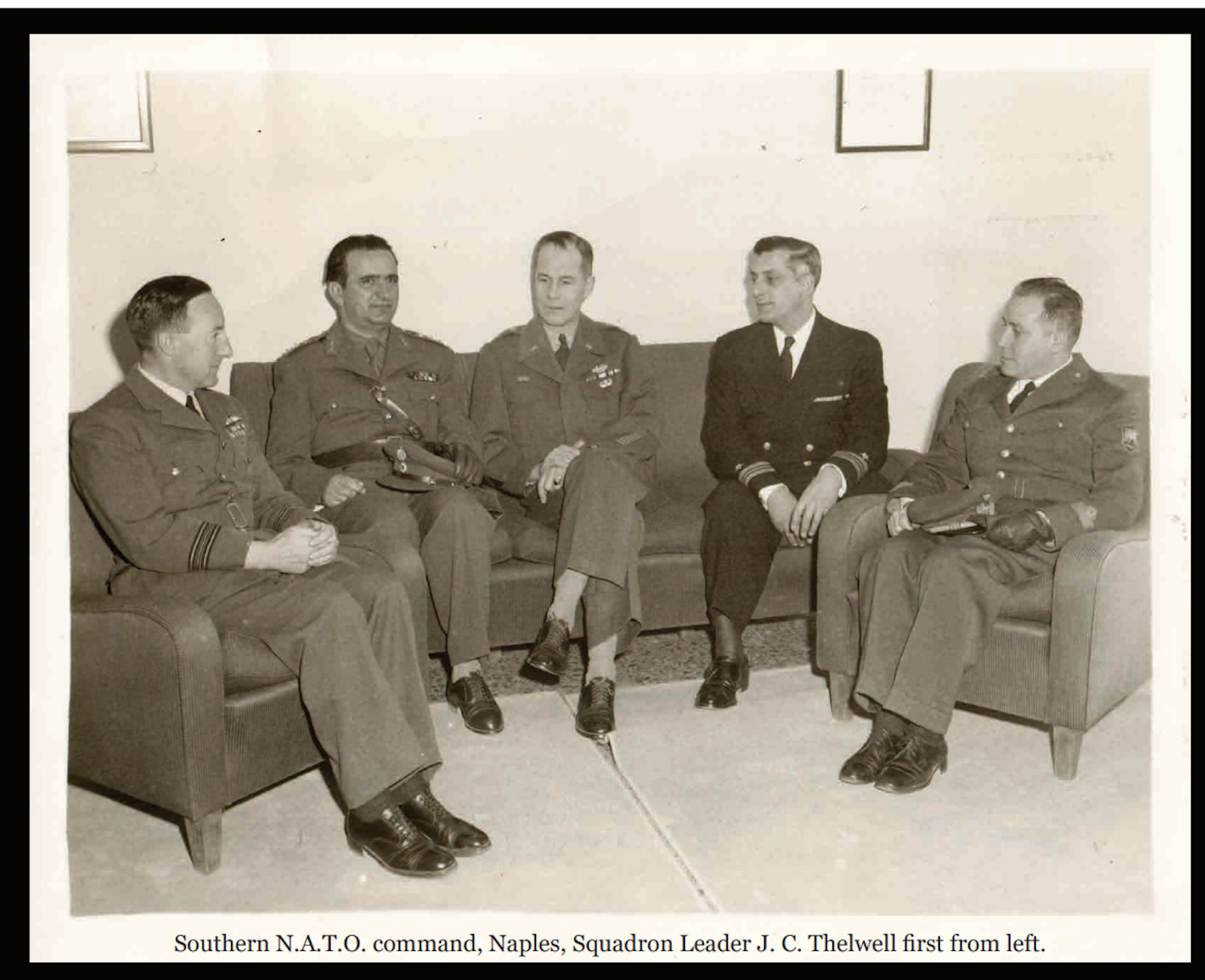
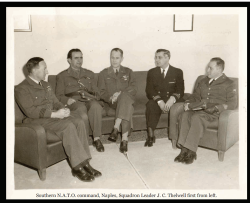
A certificate offered with this lot from N.A.T.O. Headquarters – Allied Forces Southern Europe, Plans and Operations Division, Naples,
confirms some interesting high-level service between April 1953 to January 1956, after which he retired from further R.A.F. service on 7
April 1956.
He died at St. Austell, Cornwall, on 6 July 1987, and was buried at Penmount Crematorium, Truro.